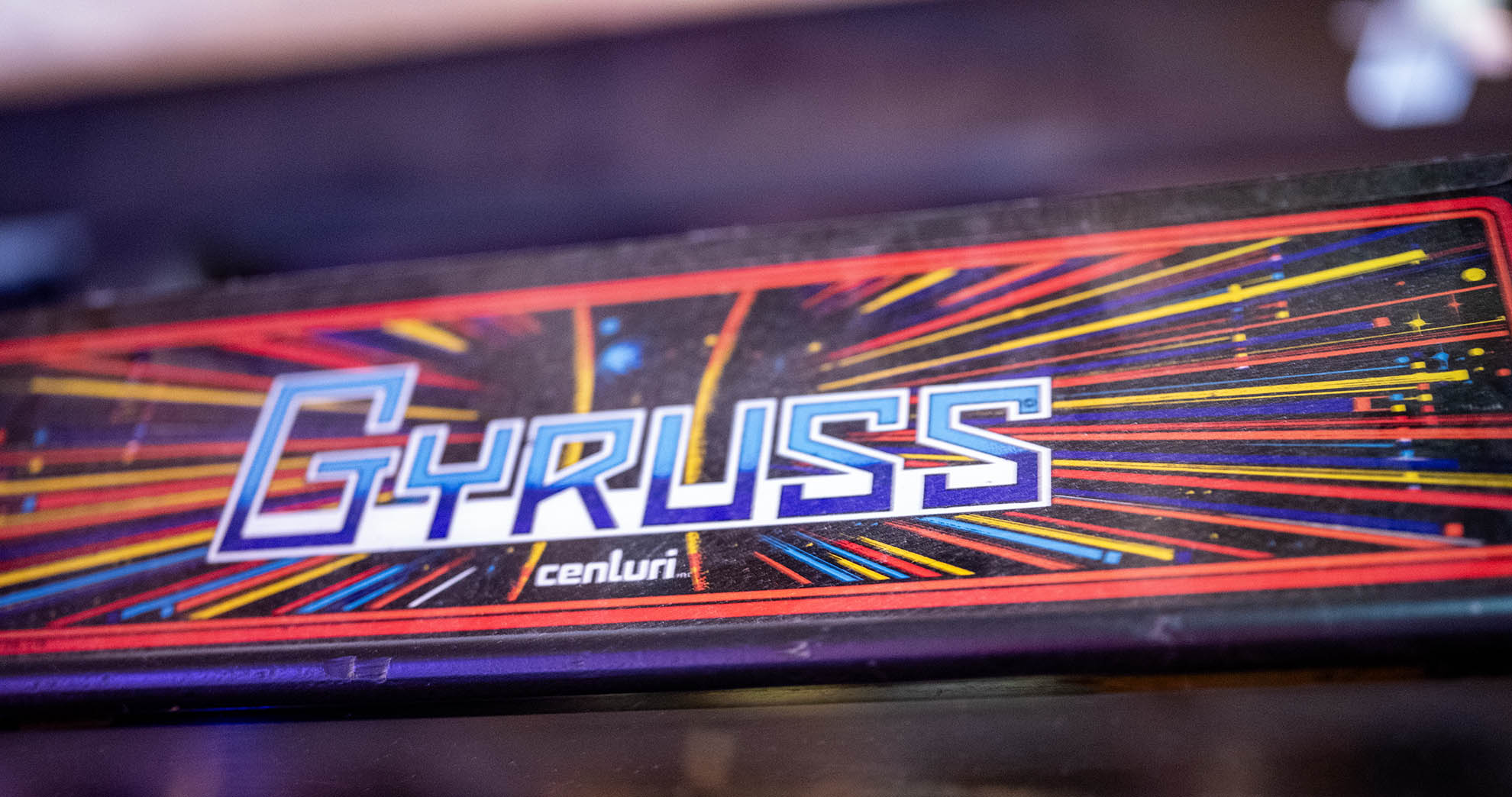
GYRUSS: When Bach Met Konami and Changed Arcades Forever (1983)
Gyruss (1983) featured Bach's Toccata on 5 audio chips. Yoshiki Okamoto's final Konami game before producing Street Fighter II. Holds 49-hour marathon record.
The Sound That Changed Arcades
Before GYRUSS, arcade soundtracks were bleeps and bloops, functional, forgettable, interchangeable. Composer Masahiro Inoue had a different vision entirely. Using an unprecedented array of five AY-3-8910A programmable sound generator chips, Inoue created something the arcade world had never experienced: a stereophonic arrangement of Bach's most iconic organ work that enveloped players in genuine musical theater.
The technical achievement cannot be overstated. Most arcade games of the era used a single sound chip producing mono audio. GYRUSS deployed five chips working in concert through discrete analog circuits to create true stereo separation. When you stood at that cabinet, Bach didn't just play, it surrounded you, with bass frequencies rolling from one speaker while melodic lines cascaded from another. The effect was hypnotic, almost religious, and completely unprecedented in coin-operated entertainment.
Inoue's arrangement stripped away the Gothic organ timbre and rebuilt the piece with electronic precision, transforming 18th-century counterpoint into a synth-wave battle hymn. Players weren't just feeding quarters into a machine; they were participating in something that felt culturally significant. The music elevated the entire experience, making every destroyed alien formation feel like a movement in a larger symphony.
Yoshiki Okamoto's Swan Song at Konami
Behind GYRUSS stands one of gaming's most consequential origin stories. Designer Yoshiki Okamoto had joined Konami as a young developer and created his first game, Time Pilot, in 1982, an innovative shooter that let players fly freely in any direction across different time periods. Time Pilot was a hit, establishing Okamoto as a rising talent.
GYRUSS was his follow-up, and it would be his last game for Konami under the most dramatic circumstances imaginable. According to industry accounts, Okamoto approached management seeking a raise after his games had performed exceptionally well. The response was not what he expected. Rather than rewarding their successful designer, Konami terminated his employment.
The firing proved to be one of the most consequential mistakes in gaming history. Okamoto walked straight into Capcom's waiting arms, where he would go on to design 1942 (1984), help shape the direction of the company's arcade division, and ultimately produce Street Fighter II, the game that would revolutionize fighting games and generate billions in revenue. Every hadouken thrown, every combo executed, every tournament held traces its lineage back to the designer Konami let walk away after GYRUSS.
Knowing this history adds a poignant dimension to playing GYRUSS today. This is the work of a creator at the peak of his abilities, pouring everything into what he didn't know would be his final Konami project. The precision of the gameplay, the ambition of the audio, the careful balancing of challenge and reward, it all reflects a designer determined to prove his worth, which he did magnificently.
Journey to Earth: The Gameplay Revolution
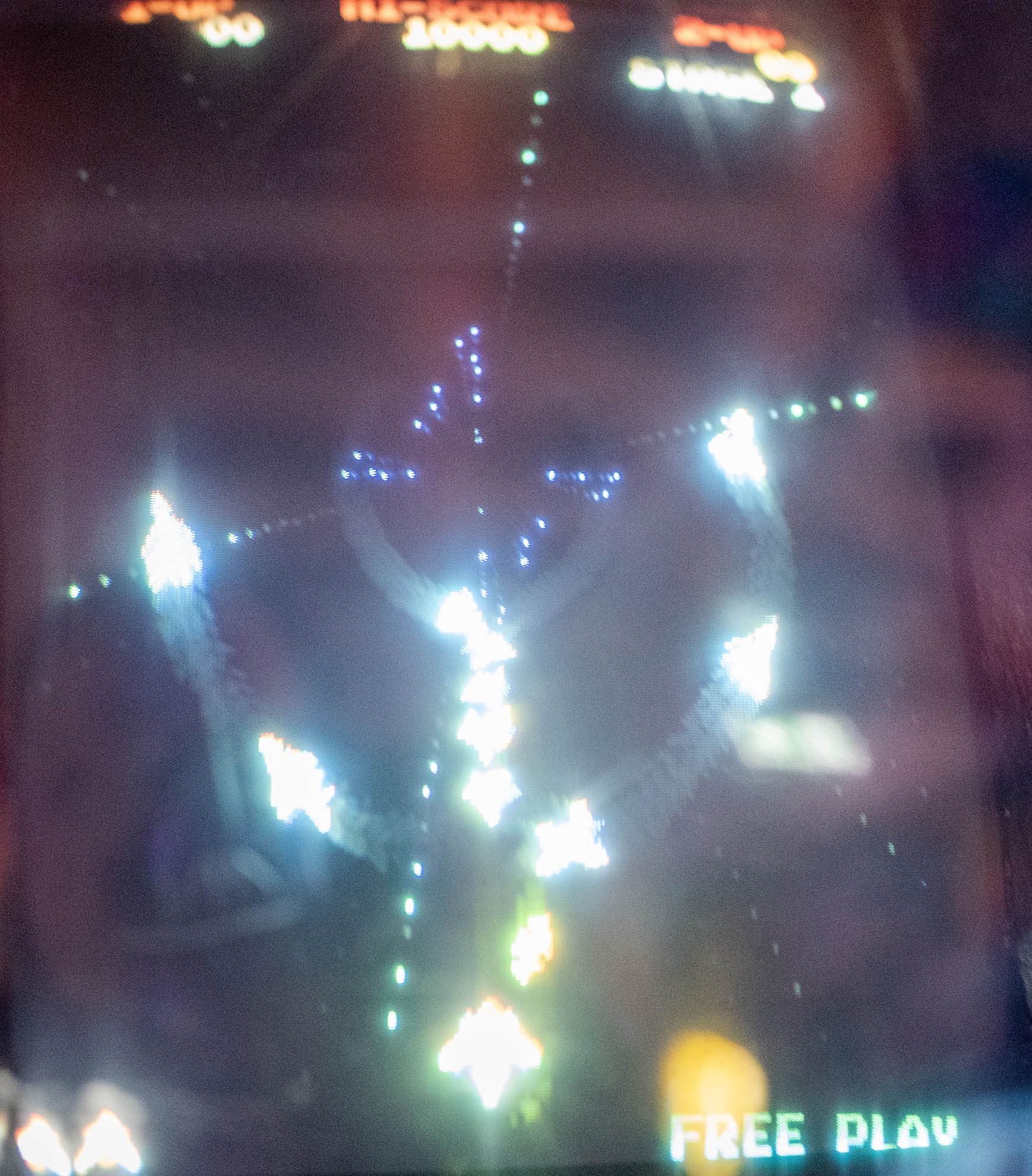
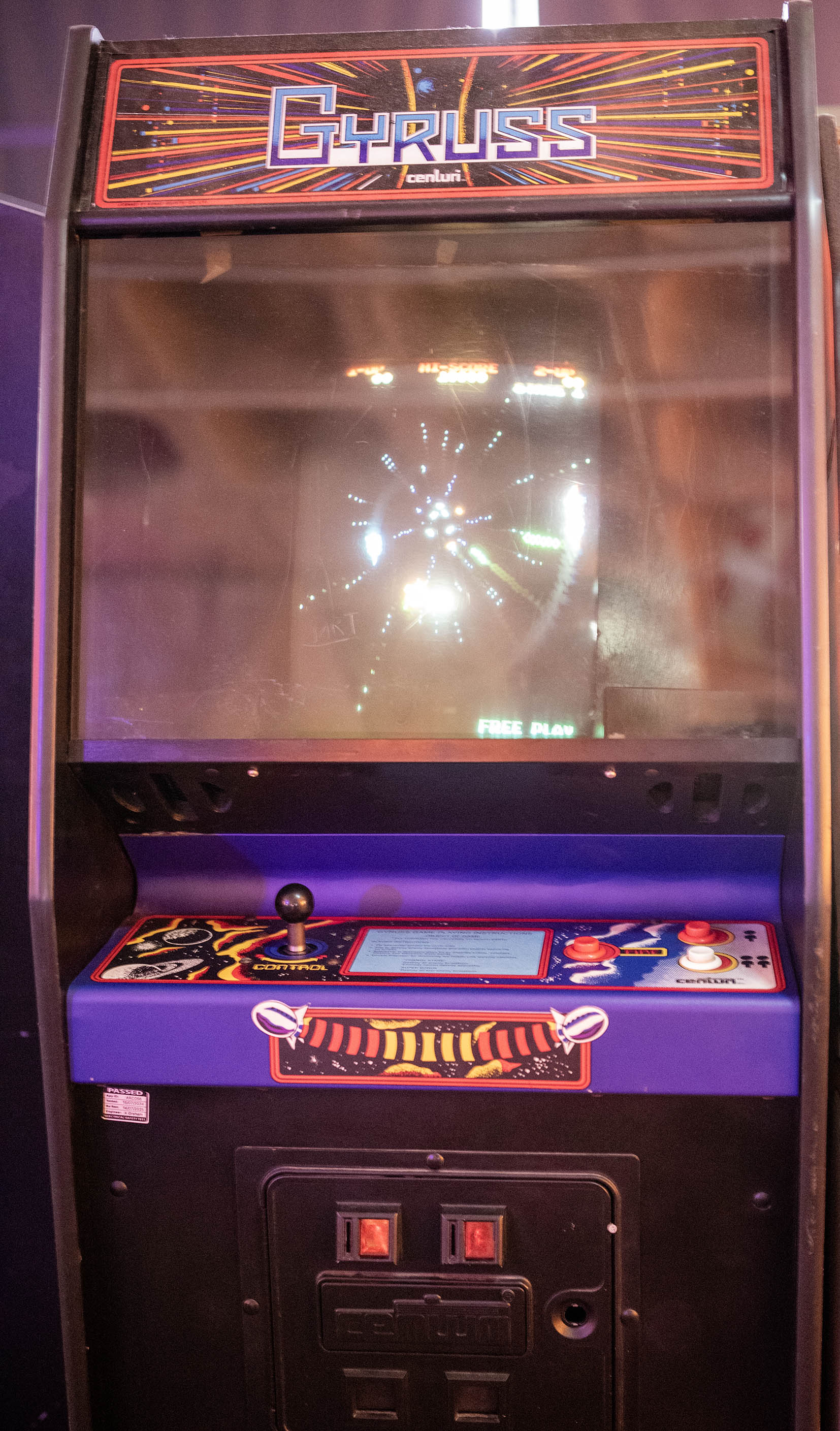
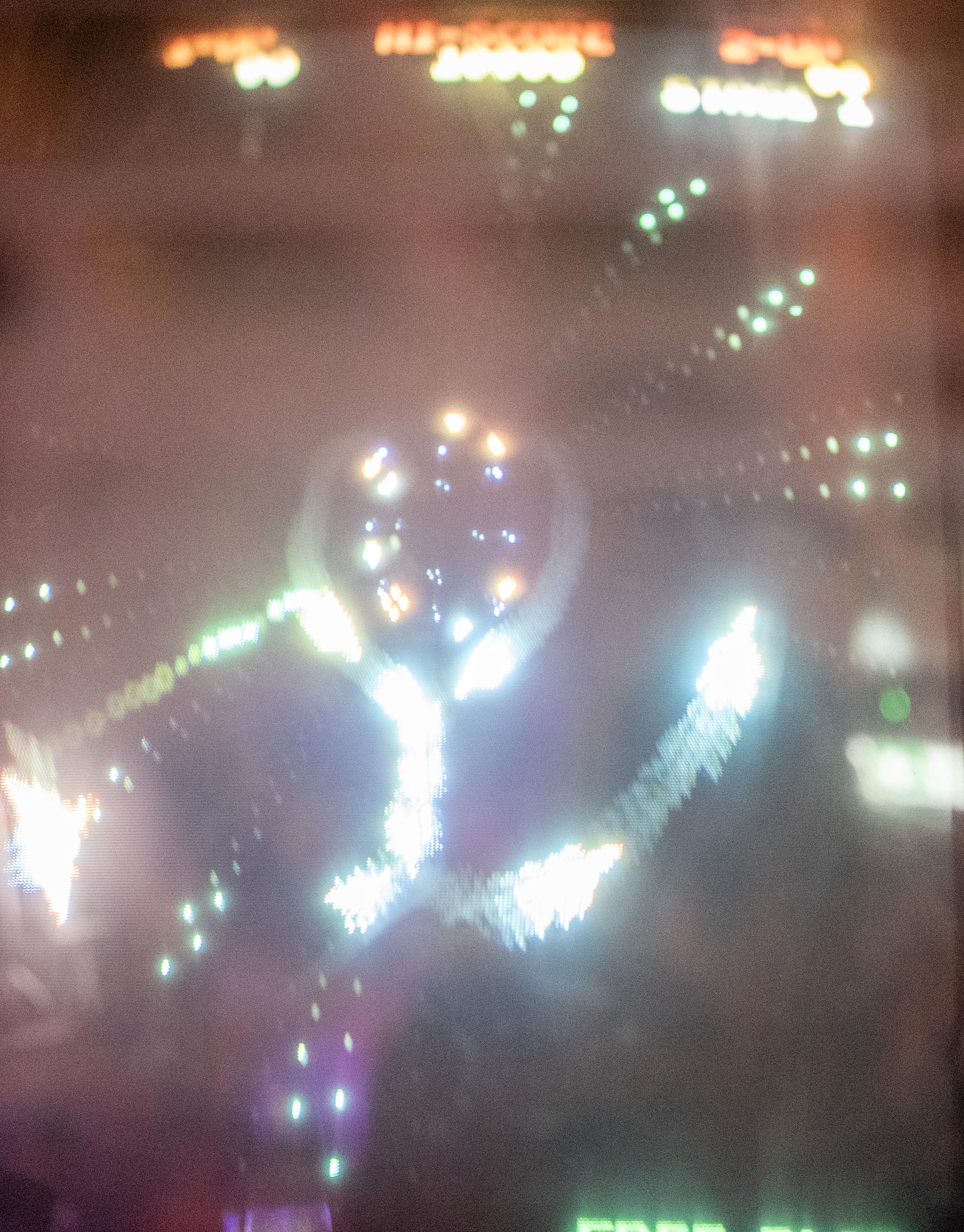
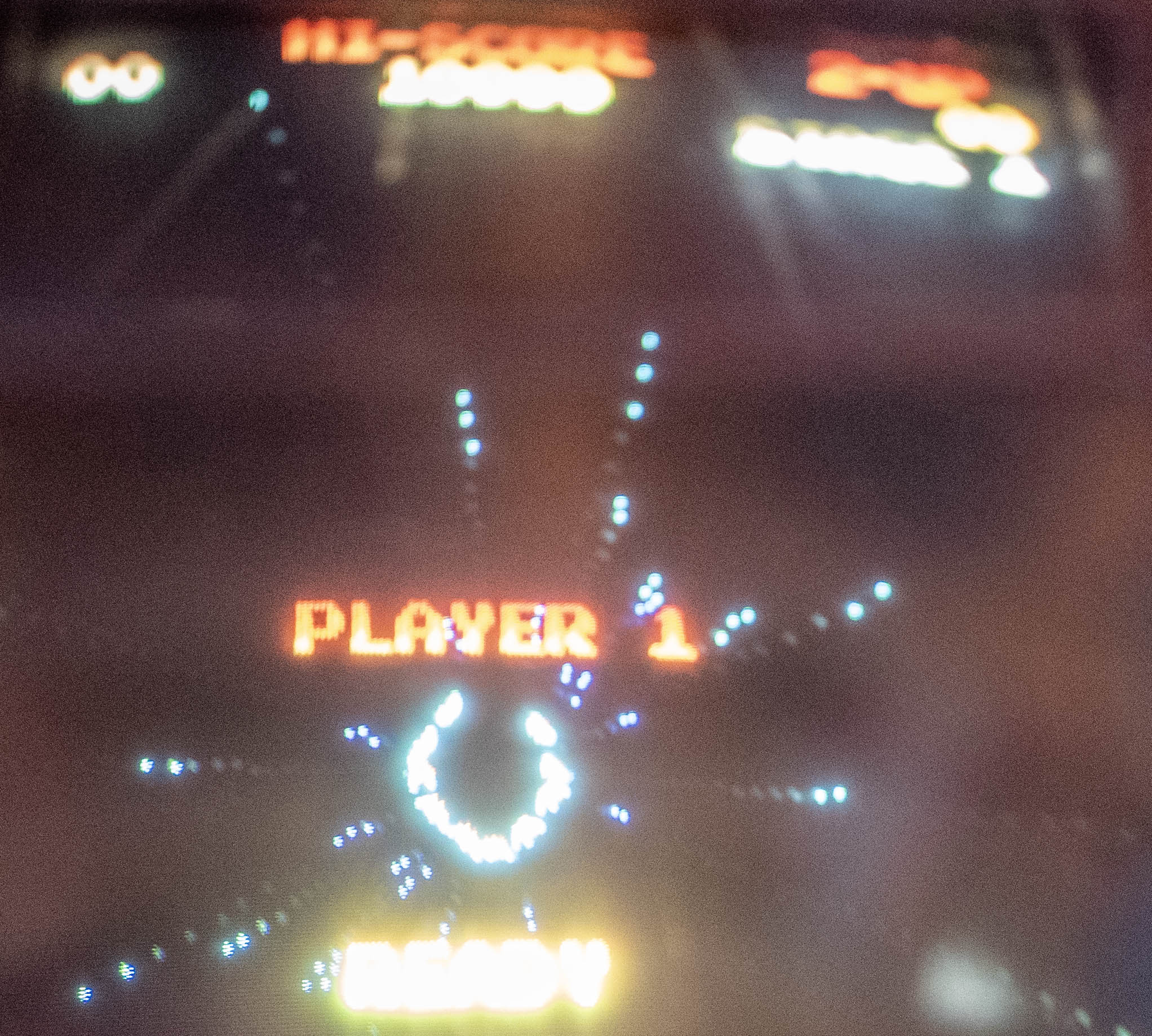
GYRUSS took the basic concept of Galaga, enemy waves, pattern recognition, precise shooting, and literally wrapped it around itself. The playing field wasn't a flat plane but a tube extending toward a central vanishing point. Your ship moved in a circle around the perimeter while enemies emerged from the center, spiraling outward in elaborate attack patterns.
The concept was simple but the execution was revolutionary. One-point perspective rendering created an illusion of depth that felt genuinely three-dimensional on 1983 hardware. Enemies didn't just appear; they emerged from that central point like threats materializing from hyperspace, growing larger and more dangerous as they approached. The visual effect was mesmerizing, turning every stage into a tunnel of impending doom that you navigated with circular precision.
The journey structure gave GYRUSS a narrative arc unusual for shooters of its era. You begin at Neptune, the outer edge of our solar system, and fight your way inward toward Earth across 24 stages. Every two or three stages, you reach another planet: Uranus, Saturn, Jupiter, Mars, and finally Earth. The "THREE WARPS TO NEPTUNE" screen became iconic, promising salvation if you could just survive a few more waves.
Power-ups added strategic depth. Destroying special formations awarded double-shot capability, transforming your single laser into a devastating twin beam. The skill ceiling was immense, expert players learned to manipulate their circular position to create optimal firing angles, threading shots through gaps in enemy formations while simultaneously dodging return fire. It rewarded mastery without punishing newcomers, that delicate balance that separates classic games from forgotten ones.
Commercial Dominance
The American arcade market of 1983 was approaching the video game crash that would devastate the home console industry, but coin-operated gaming remained robust for quality titles. GYRUSS didn't just survive this environment, it thrived.
In Japan, Game Machine magazine listed GYRUSS as the seventh most successful table arcade unit of June 1983. The game debuted on the American RePlay arcade charts and climbed to a peak position of #6, remaining on the charts for 17 consecutive months, an extraordinary run that testified to the game's enduring appeal.
Operators loved GYRUSS because players loved GYRUSS. The Bach soundtrack drew curious onlookers; the addictive gameplay converted them into repeat customers. It was the perfect arcade formula: audiovisual spectacle to attract attention, depth of play to maintain it.
Guinness World Records: The Ultimate Test
No discussion of GYRUSS is complete without acknowledging the extraordinary dedication of its competitive community. In July 1987, Michael Bangs established the original high score record at 47,024,400 points, a mark that stood for an incredible 27 years, outlasting the arcade era itself.
The current record belongs to Kim Köbke, known in gaming circles as "Kanonarm," who achieved 70,736,950 points in 2019 during a 62-hour, 23-minute marathon session. Köbke first shattered Bangs' long-standing record in 2014, scoring 62,200,250 points over 49 hours at Chassis Arcade in Copenhagen. His remarkable dedication became the subject of the 2021 documentary "Cannon Arm and the Arcade Quest," which chronicles his audacious attempt to play GYRUSS for 100 consecutive hours. Nearly four days of continuous play, circling that tube, fighting toward Earth again and again. The film reveals the physical and mental toll of such an attempt, the community that supports these endeavors, and the particular madness required to push a 1983 arcade game to its absolute limits.
That a documentary exists about achieving a high score in GYRUSS speaks to the game's lasting cultural footprint. Forty years after release, people are still finding new depths to explore, new records to chase, new stories to tell about standing in front of that cabinet.
Technical Specifications
The GX-347 board powering GYRUSS represented serious hardware for 1983. The main CPU was a Z80 running at 3.072 MHz, handling game logic and enemy patterns. A secondary Motorola M6809 processor at 2 MHz managed the complex audio requirements, supported by a dedicated sound Z80 and Intel 8039 microcontroller. This multi-CPU architecture was relatively advanced for the era, allowing the game to maintain smooth gameplay while simultaneously driving that elaborate soundscape.
The five AY-3-8910A chips deserve special mention. Each chip could produce three channels of square wave audio plus noise generation. Multiply that by five and add the discrete analog mixing circuits required for stereo separation, and you have an audio subsystem more complex than many home computers of the period. The investment in sound hardware directly reflected Konami's understanding that GYRUSS's audio would be its primary differentiator.
Video output ran at standard arcade resolution with the tube effect achieved through clever sprite scaling and positioning. The central vanishing point wasn't true 3D rendering but a masterful illusion created through careful programming. Watch the enemy sprites grow as they approach, that smooth scaling was a technical achievement given the limited resources available.
Home Ports: Bringing GYRUSS Home
Parker Brothers secured the home console rights and released GYRUSS ports in June 1984 for the Atari 2600, Atari 5200, ColecoVision, and Atari 8-bit computers. The conversions varied in quality based on hardware limitations, with the ColecoVision and Atari 5200 versions generally considered the most faithful to the arcade experience.
The definitive home version arrived when Konami published GYRUSS for the Famicom Disk System in Japan (November 1988) and the Nintendo Entertainment System in North America (February 1989). This wasn't merely a port but an expansion, the NES version featured 39 stages instead of the arcade's 24, adding Mercury, Venus, and the Sun as destinations while introducing new enemy types, boss battles, and the iconic Ultra-Lazonic Phaser power-up. The extended journey transformed GYRUSS from an arcade quarter-muncher into a proper home console adventure while retaining the circular gameplay that defined the original.
Legacy: The Tube Shooter's Lasting Impact
GYRUSS established the tube shooter as a viable arcade subgenre and influenced countless games that followed. Its one-point perspective rendering would be refined and expanded in titles like Tempest 2000 and countless rail shooters. The idea that classical music could elevate gaming, that a Bach arrangement wasn't pretentious but genuinely enhancing, opened doors for composers who wanted to bring sophistication to the medium.
More broadly, GYRUSS represents a particular moment in arcade history when developers were pushing against every limitation, finding creative solutions to hardware constraints, and believing that arcade games could be experiences rather than merely diversions. The game demanded attention with its audio, rewarded attention with its gameplay, and respected players enough to offer genuine depth beneath its accessible surface.
For those of us who were there, who fed quarters into that cabinet while Bach played and aliens spiraled. GYRUSS remains a touchstone. It proved that arcades could offer something beyond simple entertainment, that the combination of music, visuals, and gameplay could create genuine art. Forty years later, that central tunnel still beckons, promising a journey from the outer planets back to Earth, one warp at a time.
All arcade cabinet photos taken by the author at The Pixel Bunker.
For more arcade classics, see Street Fighter II and Hang-On.\n\nThere's a moment every arcade veteran remembers with crystalline clarity: the first time they heard Johann Sebastian Bach's Toccata and Fugue in D minor thundering through an arcade cabinet, electronic and unmistakable, drawing them toward a spinning tunnel of alien destruction. That moment was GYRUSS, and in 1983, it changed what we expected from arcade games forever.
Game Information
| Title | Gyruss (ジャイラス) |
| Developer | Konami |
| Designer | Yoshiki Okamoto |
| Release | March 1983 (Japan) / April 1983 (North America) |
| Platform | Arcade (Model GX-347) |
| Genre | Tube Shooter / Fixed Shooter |
| Publisher (NA) | Centuri |
Gallery
Get Gaming News and Features First
Stay updated with the latest gaming news and exclusive content.