Lethal Enforcers II: Gun Fighters - Konami's Wild West Shootout That Defined an Era
Konami's 1994 Lethal Enforcers II: Gun Fighters brought Wild West action with digitized graphics, mirror cabinet, and skeleton bosses to arcades.
From Mean Streets to Main Street
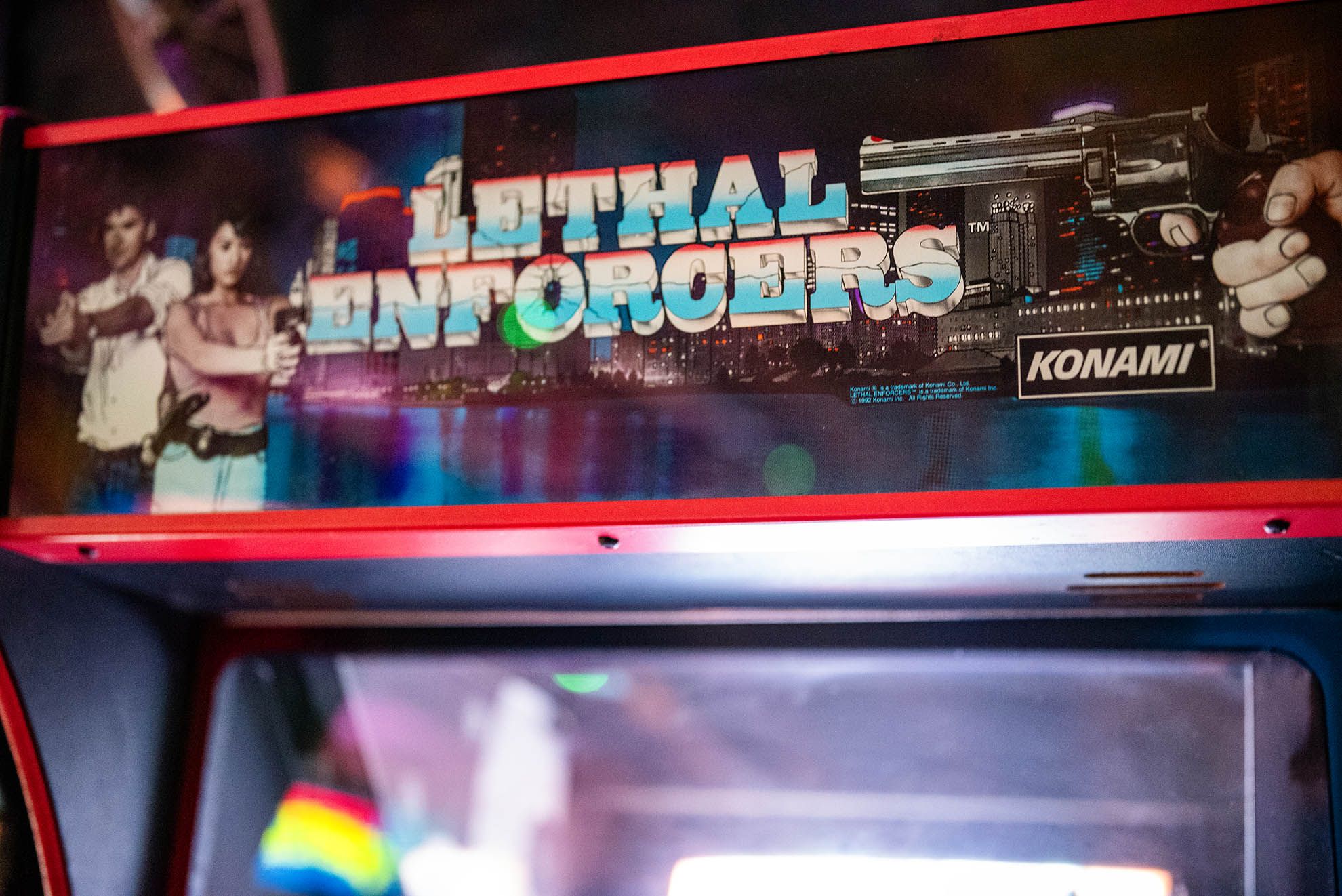
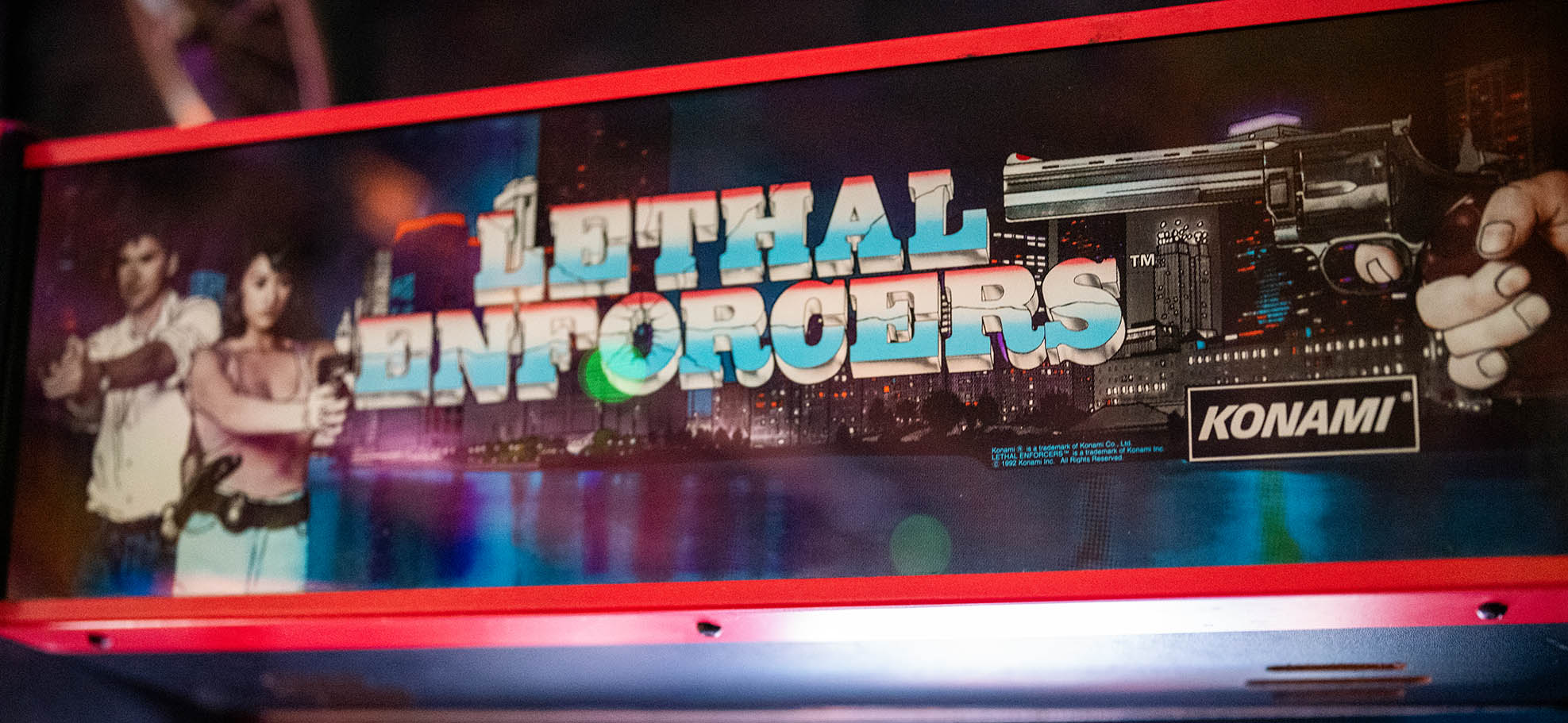
The original Lethal Enforcers arrived in arcades in October 1992, and immediately caused a sensation. It was Konami's first arcade light gun shooter, and its innovation was simple but revolutionary: instead of cartoon graphics, every character on screen was a digitized photograph of a real person. Konami USA employees donned costumes and posed as criminals for the camera, creating photorealistic (if pixelated) sprites that made shooting feel uncomfortably authentic.
The result was spectacular commercial success, and intense controversy. Lethal Enforcers topped arcade earnings charts from December 1992 through January 1993 and became one of the top five highest-grossing dedicated arcade games of 1993 in the United States. But it also landed directly in the crosshairs of Senator Joe Lieberman's congressional hearings on video game violence in December 1993. Lieberman famously held up the home console version's Justifier light gun, designed to resemble a realistic revolver, and questioned whether games like this were appropriate for young players.
The controversy only amplified the game's popularity. When Konami's American development team began work on a sequel, they made a strategic decision: shift the setting to the Old West, where the violence of gunfighting was historical rather than contemporary, and where six-shooters were the expected tools of the trade.
Saddle Up, Sheriff
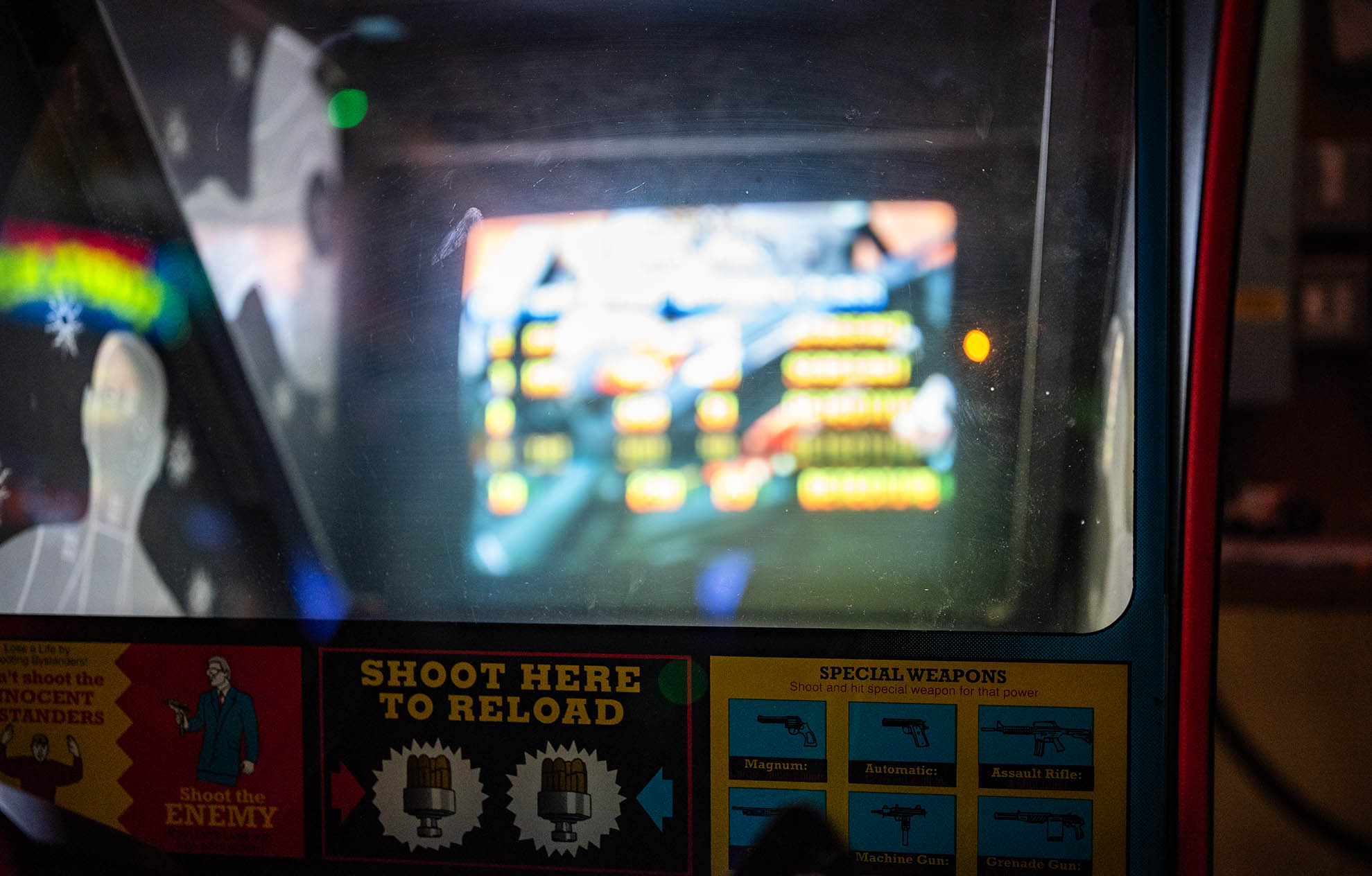
Lethal Enforcers II: Gun Fighters, known as Lethal Enforcers 2: The Western in Japan, casts players as frontier lawmen tasked with bringing order to a town overrun by desperados. The game unfolds across five distinct stages, each recreating a quintessential Western scenario:
Stage 1: The Bank Robbery - The adventure begins with classic cowboy mayhem as outlaws storm the local bank. The first boss attacks with a line of three cannons firing infinite cannonballs, setting the tone for the game's over-the-top encounters.
Stage 2: The Stage-Holdup - Players escort a stagecoach through hostile territory, constantly gunning down bandits before they can damage the coach or complete their robbery. The boss hurls infinite explosive barrels from the back of a fleeing stagecoach, creating a frantic chase sequence.
Stage 3: Saloon Showdown - The notorious "Bad Guy Bar" culminates in the game's most unique boss encounter: a quick-draw duel against three gunslingers (six in two-player mode). This showdown mini-game stands apart from the standard boss battles, testing reflexes in a classic Western format. Notably, this duel takes place at midnight, subverting the traditional "High Noon" trope.
Stage 4: The Train Robbery - A fan-favorite level that moves through multiple train cars, each containing different surprises. Bad guys station themselves in unexpected positions, with dynamite-throwing bosses that present a serious challenge. The variety keeps players on their toes throughout this extended sequence.
Stage 5: The Hide-Out - The final confrontation takes the game in an unexpected supernatural direction. After fighting through the outlaws' stronghold, players face a boss who transforms into a skeleton upon defeat, a genuinely disturbing twist for an otherwise historically-grounded game. This undead villain summons fireballs that can be dispelled by shooting and commands skeleton minions who hurl tomahawks. Most unsettling: if you destroy a skeleton's body without hitting its head, the detached skull flies directly at you for a last desperate attack.
The Arsenal of Justice
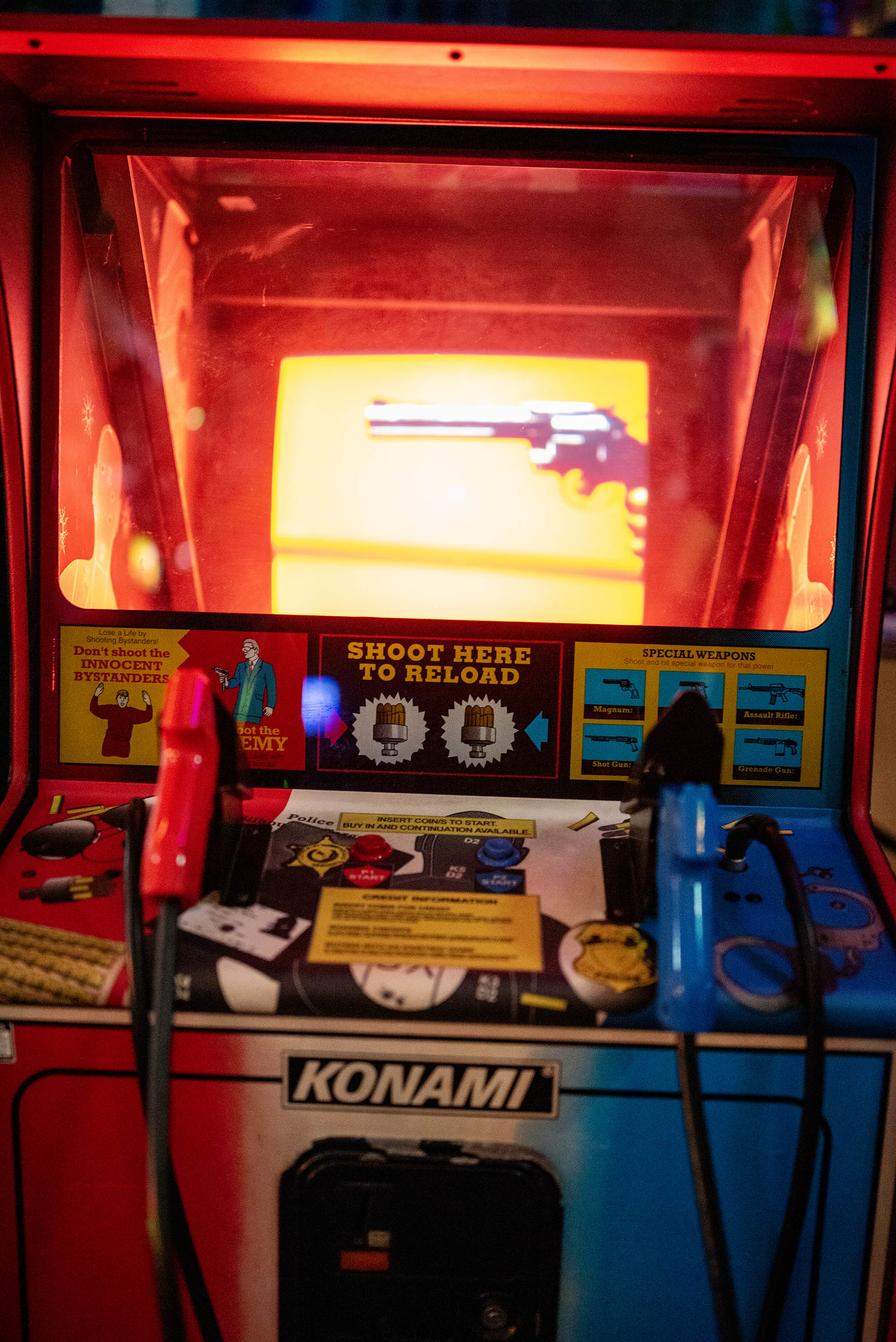
Like its predecessor, Gun Fighters offers an escalating arsenal of frontier firearms. Players begin with a standard six-shooter holding six bullets and can acquire upgraded weapons by shooting their on-screen icons:
- Double Rigs - Two pistols for faster firing
- .50 Caliber Sharps A powerful rifle for precision distance shooting
- Shotgun Spread fire for crowd control
- Gatling Gun Twenty-four rounds of rapid fire (single-use, cannot be reloaded)
- Cannon Seven devastating shots (single-use, cannot be reloaded)
Most weapons can be reloaded indefinitely by shooting off-screen, but the Gatling gun and cannon are powerful single-use pickups. Taking a hit from an enemy reverts your weapon to the basic six-shooter. This creates an addictive risk-reward loop: skilled players maintain their upgraded firearms while absorbing the game's challenges, while those who get hit frequently find themselves back at square one.
Unlike the machine guns and grenade launchers of the modern-set original, Gun Fighters keeps its weapons period-appropriate, maintaining the Western atmosphere while still providing the firepower variety that made the series popular.
The Cabinet That Fooled the Eye
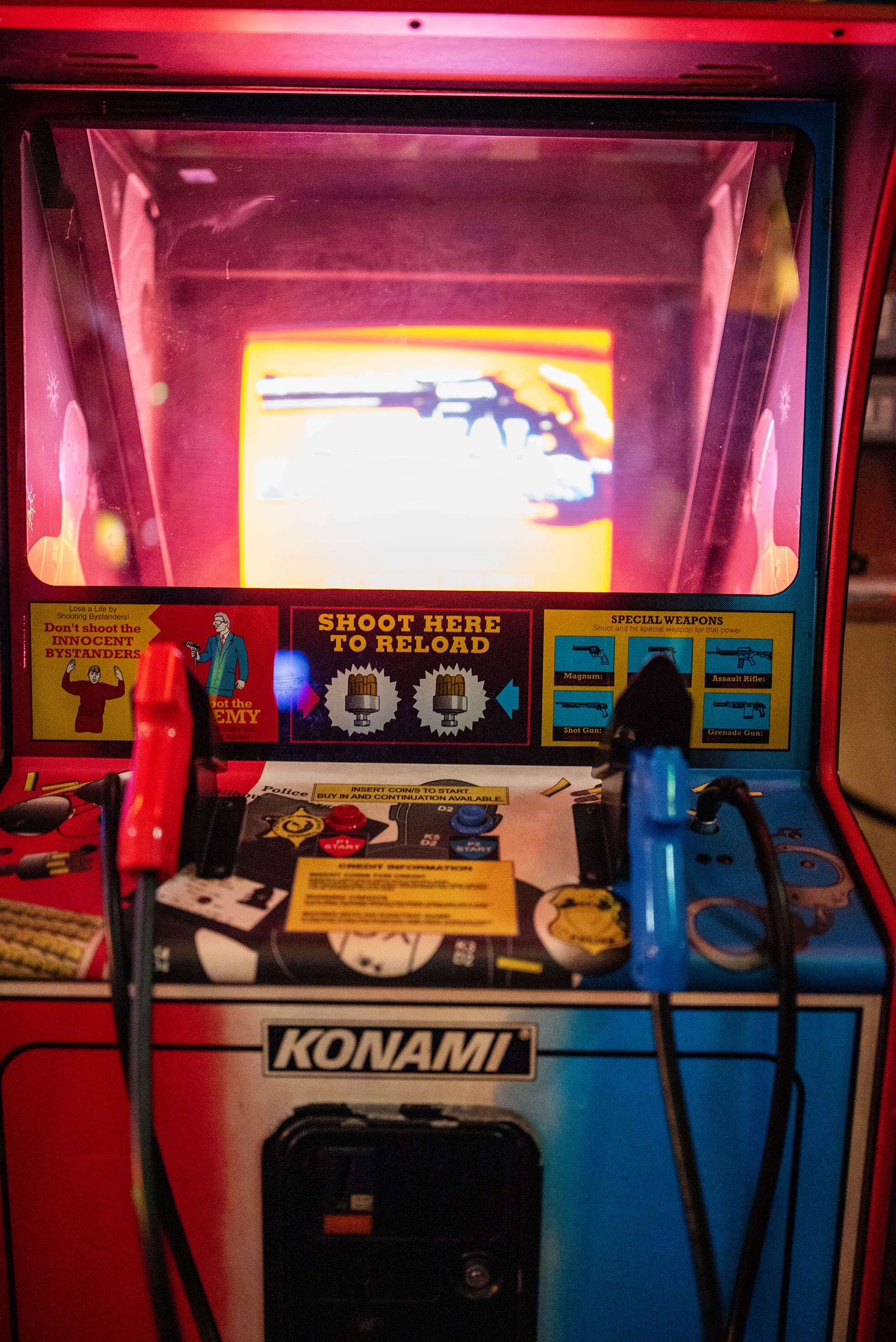
Lethal Enforcers II's arcade cabinet remains a remarkable piece of engineering. Standing 72 inches tall, 62.5 inches wide, and 59 inches deep, this over-1,000-pound behemoth used a clever optical trick to create the illusion of depth. The monitor was actually positioned horizontally at the bottom of the cabinet, with its image reflected off a large angled mirror to reach the player's eye level.
This mirror system, while adding to manufacturing complexity and weight, created a visual presentation that felt more immersive than standard upright cabinets. The reflected image had a quality that players described as almost holographic, adding to the frontier atmosphere.
The cabinet's light guns were designed as Western-style revolvers appropriate to the setting, using optical detection technology. A dip switch allowed arcade operators to configure the game for either linear progression ("arcade mode") or stage selection ("street mode"), giving venues flexibility in how they presented the experience.
Under the Hood: Konami GX Power
Gun Fighters ran on Konami's GX hardware, a powerful arcade system board introduced in 1994. The configuration included a Motorola 68EC020 running at 24 MHz as the main CPU, a Motorola 68000 at 9.2 MHz handling sound, and dual K054539 chips operating at 48 kHz. The game was identified as GX312 in Konami's catalog.
The GX system was capable of impressive graphical effects for its era and would go on to power several other notable Konami titles including Sexy Parodius, Salamander 2, and Twin Bee Yahhoo!. The hardware came in two PCB configurations: the larger, warmer-running Type 1, and the more compact Type 2 with consolidated chips.
The system's audio capabilities shone in Gun Fighters, though home port reviewers would later note that the endless repetition of enemy voice lines ("You ain't gonna get me, sheriff!") could become grating during extended play.
Tom duBois: The Final Illustration
The North American box art and promotional materials for Lethal Enforcers II featured the work of Tom duBois, one of gaming's most celebrated commercial illustrators. A graduate of the American Academy of Art in Chicago, duBois had been creating iconic cover paintings for Konami since 1988, starting with Blades of Steel.
His portfolio reads like a who's who of classic gaming: Contra III: The Alien Wars, Castlevania: Bloodlines, Rocket Knight Adventures, Sunset Riders, and Teenage Mutant Ninja Turtles IV: Turtles in Time. Most commissions required completion within a single week, and duBois rarely, if ever, actually played the games he illustrated.
When asked about his favorite works, duBois cited Lethal Enforcers II: Gun Fighters specifically: "I like that one because it's simple. It reminds me of the HBO series 'Deadwood,' but it was done long before that came out." This would prove to be duBois's final illustration for Konami. The company switched advertising agencies around 1993-1994, ending one of gaming's most distinctive visual partnerships.
The Digitized Difference
Gun Fighters continued the series' signature use of digitized photography, with Konami USA employees once again dressing in costume to portray the game's cast of outlaws and innocents. Every bandit, every bystander, every wanted poster featured real human faces captured on film and processed into sprites.
This technique, which Konami had pioneered alongside Midway's Mortal Kombat, created a visual style that was simultaneously cutting-edge and instantly dated. The limited color palettes and blocky resolution of 1994 hardware meant these "photorealistic" graphics aged quickly, but they also gave the games an unmistakable aesthetic that remains recognizable decades later.
The approach would dominate light gun shooters until Sega AM2's Virtua Cop arrived later in 1994, replacing digitized sprites with 3D polygon graphics and ushering in a new era for the genre.
Chart Performance and Critical Reception
Lethal Enforcers II performed strongly in arcade charts upon release. RePlay magazine ranked it the fourth most popular upright arcade game in the United States for May 1994, while Play Meter listed it as the ninth most popular arcade game that June. In Japan, Game Machine ranked it the seventh most successful upright/cockpit arcade unit of November 1994.
Reviews for the home ports varied by platform. GamePro awarded the Genesis version a perfect 5 out of 5 across all four categories (graphics, sound, control, fun factor), praising the variety of weapons, sharp digitized sprites, and the Justifier's accuracy. Electronic Gaming Monthly was more reserved with a 31 out of 50, though they still praised the two-player mode and weapon variety.
The Sega CD version was noted to be "generally identical to the Genesis version but has more voices" with clearer audio. EGM gave it a slightly higher 33 out of 50, acknowledging improved music and sound effects while warning that the game was significantly more difficult than the first Lethal Enforcers.
Some critics noted that the Genesis's limited color palette made the game's already brown-heavy Western environments look particularly muddy. As one reviewer put it: "The system's color palette really comes through here. Be prepared to see a lot of different shades of brown."
Home Versions and Legacy
Gun Fighters received ports to Sega Genesis/Mega Drive in May 1994 (compatible with the Konami Justifier light gun, though the peripheral was sold separately unlike the first game), Sega CD/Mega CD in November 1994 with enhanced audio but otherwise identical gameplay, and PlayStation in November 1997 bundled with the original game as "Lethal Enforcers Deluxe Pack" (or "Lethal Enforcers I & II" in the West), developed by Konami Computer Entertainment Chicago.
The PlayStation compilation in particular ensured the games remained accessible well into the 32-bit era, though the shift away from CRT televisions has made these light gun games increasingly difficult to play on modern displays.
The Collector's Scene
Today, the International Arcade Museum census counts 89 known Lethal Enforcers II machines in active collector hands: 52 original dedicated cabinets, 6 conversions, and 31 circuit boards only. The game's massive cabinet size and the mirror mechanism's fragility make complete, working units relatively rare.
The gun peripherals present their own challenges. The original Konami light gun connectors don't easily interface with other PCBs, making cross-compatibility projects difficult. Collectors seeking authentic experiences often find themselves hunting for the specific guns designed for this system.
World Records
Competitive Lethal Enforcers II play is tracked by Twin Galaxies, though the scoring nature of rail shooters means records reflect endurance and efficiency rather than pure high scores in the traditional sense.
The current verified arcade record for "Points [Single Player Only]" stands at 1,466 points under official Twin Galaxies settings (Difficulty Level 4/Medium, 1 Play/5 Lives, Extra Life at 1000 points, additional lives every 2000 points thereafter).
For the MAME emulated version (ver EAA), Travis Warnell achieved 1,272 points as of April 21, 2016, a record verified by both Twin Galaxies and Guinness World Records. More recent submissions suggest Salim Farhat may have reached 2,104 points, though verification details vary.
The Bigger Picture
Lethal Enforcers II: Gun Fighters represents a transitional moment in arcade history. It perfected the digitized sprite approach that its predecessor pioneered, while simultaneously being rendered obsolete by the 3D polygon revolution that Virtua Cop would ignite just months later. It pushed the boundaries of violence in gaming, then sidestepped controversy by retreating to a historical setting. It created an immersive cabinet experience that would become impractical as arcade economics shifted toward cheaper, smaller units.
The game's influence echoes through subsequent Konami projects. The company would later develop Police 911 (2000), which added motion-sensing technology to the light gun formula, and Lethal Enforcers 3 (2005), actually a localization of the unrelated "Seigi no Hero" that played more like a hybrid of gun game and racing game.
As for the broader genre, Lethal Enforcers II arrived at the perfect moment to demonstrate what digitized photography could achieve, and what limitations it couldn't overcome. For another arcade deep-dive, explore Berzerk, the dream-inspired shooter that sparked the twin-stick genre. The succession of Virtua Cop, Time Crisis, and House of the Dead that followed built upon foundations that games like Gun Fighters established, even as they moved in dramatically different visual directions.
Ride Into the Sunset
Lethal Enforcers II: Gun Fighters endures as a time capsule of 1994 arcade culture: ambitious in its technology, confident in its genre, and willing to go supernatural when the Old West setting seemed too limiting. Those skeleton bosses remain genuinely unsettling, the saloon duel still quickens the pulse, and the sheer physicality of that massive cabinet, with its angled mirror and authentic Western revolvers, represented arcade design at its most theatrical.
For collectors, enthusiasts, and anyone who remembers feeding quarters into that intimidating cabinet, Gun Fighters delivers a specific kind of nostalgia that polygon-based successors can't quite replicate. There's something about shooting pixelated photographs of real people dressed as Wild West outlaws that no amount of graphical advancement has replaced.
Tom duBois's artwork may have been the last he created for Konami, but it captured something essential: the romance of the frontier, the thrill of the quick draw, and the simple satisfaction of being the fastest gun in the arcade.
| Specification | Details |
| Developer | Konami |
| Publisher | Konami |
| Release Date | March 1994 (Japan), April 1994 (North America) |
| Platform | Arcade (Konami GX) |
| Genre | Light Gun Shooter |
| Players | 1-2 |
| Cabinet Dimensions | 72" H x 62.5" W x 59" D, ~1,047 lbs |
| Display | Mirror-reflected horizontal raster |
| Main CPU | Motorola 68EC020 @ 24 MHz |
| Sound CPU | Motorola 68000 @ 9.2 MHz |
| Sound Chips | Dual K054539 @ 48 kHz |
| Game ID | GX312 |
| Controls | Light gun (Western revolver style) |
| Stages | 5 (Bank Robbery, Stage-Holdup, Saloon Showdown, Train Robbery, Hide-Out) |
| Ranks | Posse, Deputy, Sheriff, Deputy Marshal, U.S. Marshal |
| Key Staff | Yoshiaki Hatano, Jun Narita, Steve Johnson, Tetsuya Wada, T. Sekito, Yuichi Sakakura |
| Box Artist | Tom duBois (final Konami work) |
| Home Ports | Sega Genesis, Sega CD, PlayStation (compilation) |
| Arcade World Record | 1,466 points (Twin Galaxies verified) |
| Known Surviving Units | 89 (52 dedicated, 6 conversions, 31 PCBs) |
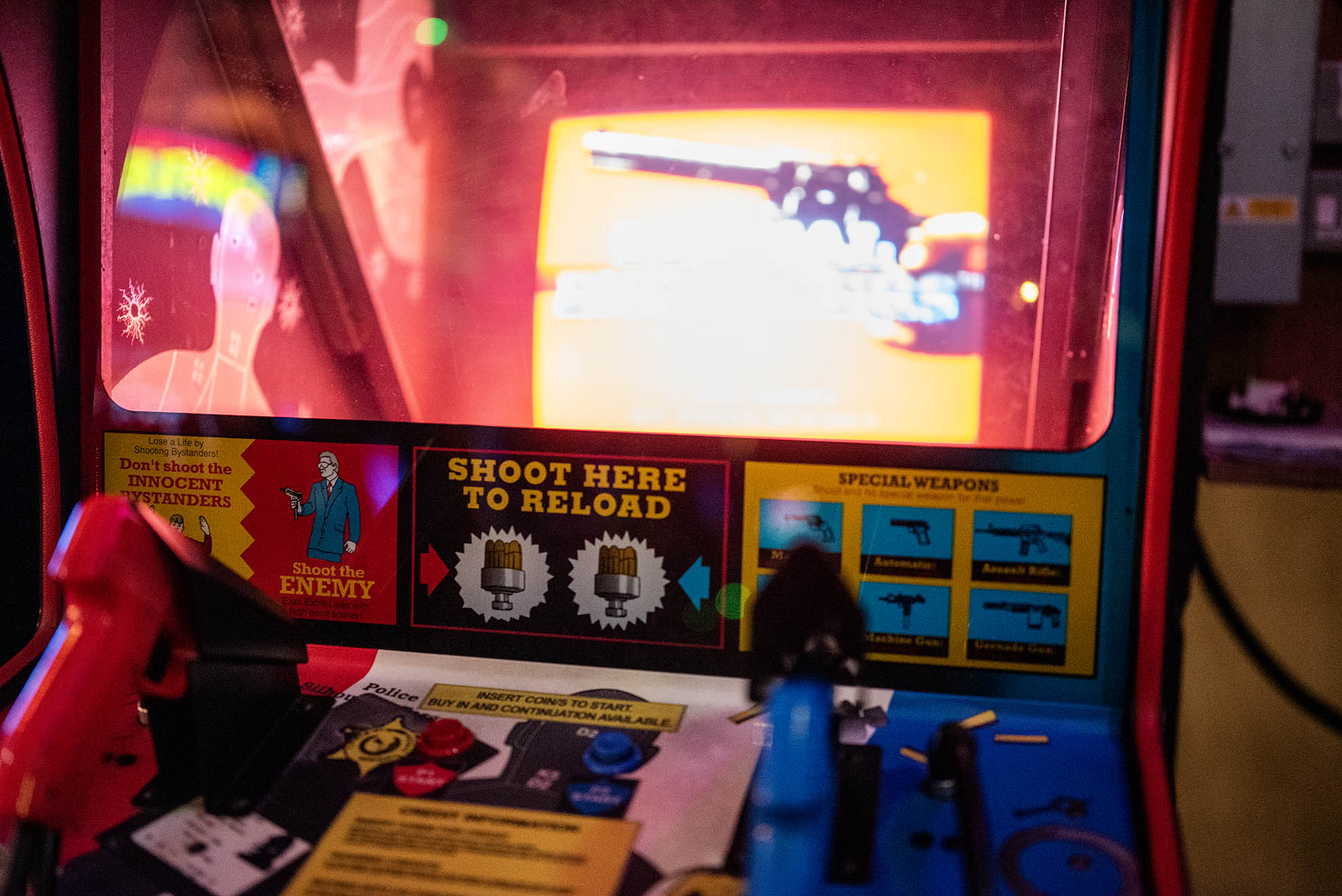
All arcade cabinet photos taken by the author at The Pixel Bunker.
Step into the dusty streets of the American frontier, where the crack of a six-shooter echoes between wooden saloon doors and outlaws lurk behind every water barrel. Released in March 1994, Lethal Enforcers II: Gun Fighters transported arcade-goers from the urban crime-fighting of its predecessor to the lawless expanse of the Wild West, creating one of the most memorable light gun experiences of the 16-bit era. For more classic Konami arcade history, see the X-Men six-player cabinet. With its digitized photography, massive mirror-based cabinet, and supernatural surprises, Konami's Western sequel proved that sometimes the best way to follow a controversial hit is to travel a hundred years into the past.
Gallery
Get Gaming News and Features First
Stay updated with the latest gaming news and exclusive content.