Xevious (1983): Namco's Arcade Masterpiece That Defined Vertical Shooters
Xevious arcade game history. Namco's 1983 vertical shooter that pioneered scrolling backgrounds, hidden secrets, and the shmup genre.
In January 1983, Japanese arcades witnessed something unprecedented: a scrolling shooter so sophisticated, so visually rich, and so narratively ambitious that it rewrote the rules for an entire genre. This was Xevious, Namco's groundbreaking vertical shooter that achieved record-breaking sales not seen since Space Invaders five years earlier. Designed by a recent college graduate who learned to program in just one month, Xevious established the template that virtually every vertical shooter would follow for the next four decades.
From Vietnam to the Stars: The Design Evolution
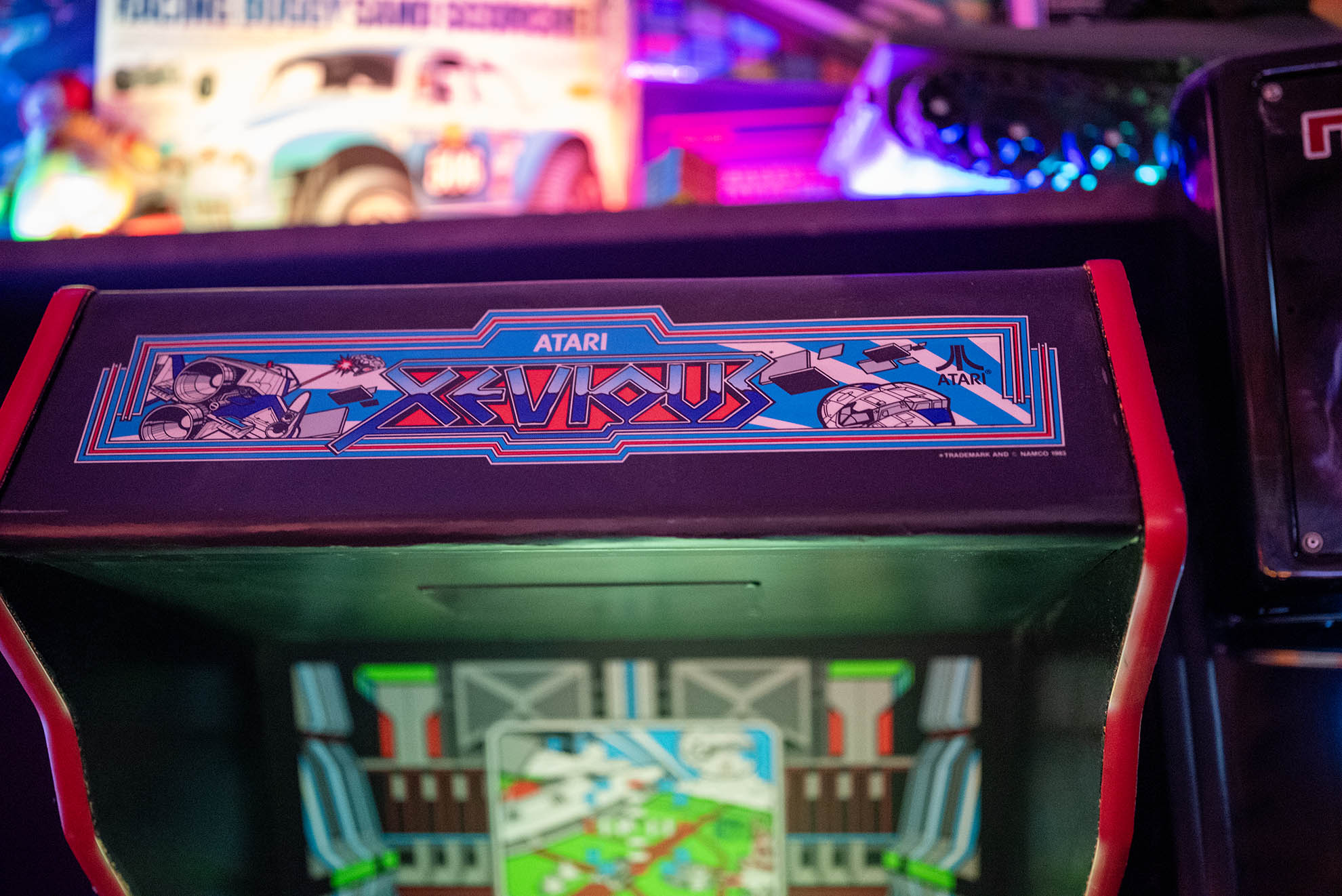
The story of Xevious begins with a corporate mandate and a name change. In 1981, Namco's marketing department tasked a small team led by newcomer Masanobu Endo with creating a two-button scrolling shooter that could rival Konami's successful Scramble (1981). The original concept, titled "Cheyenne," depicted a Vietnam War helicopter scenario - a premise that would soon transform dramatically.
When Endo, who had joined Namco in April 1981 as a planner, took greater creative control, the military realism gave way to science fiction grandeur. Drawing inspiration from Stanley Kubrick's "2001: A Space Odyssey" and ancient astronaut theories, Endo created an elaborate mythology where humanity must defend against an ancient civilization returning to reclaim Earth. The title itself evolved from "Zevious" to "Xevious" - the "X" added to sound more exotic and mysterious, with the metallic logo paying homage to the Williams pinball table Xenon.
Remarkably, Endo learned programming in just one month before beginning the project. This fresh perspective may have contributed to Xevious's innovative approach, as Endo wasn't constrained by established conventions of what a shooter "should" be.
The Technical Marvel: Namco Galaga Hardware
Xevious runs on the Namco Galaga hardware platform, a system that powered several of Namco's most important early-1980s titles. The technical specifications reveal the engineering prowess behind the game:
| Component | Specification |
| Main CPU | Three Zilog Z80 processors |
| Sound | Namco 3-channel PSG (same WSG as Pac-Man) |
| Custom I/O | Type 1 controller for inputs |
| Display | Vertical raster, 288 x 224 pixels |
| Colors | 128 on-screen from larger palette |
| Board Variants | Namco (Galaga pinout) / Atari (unique pinout) |
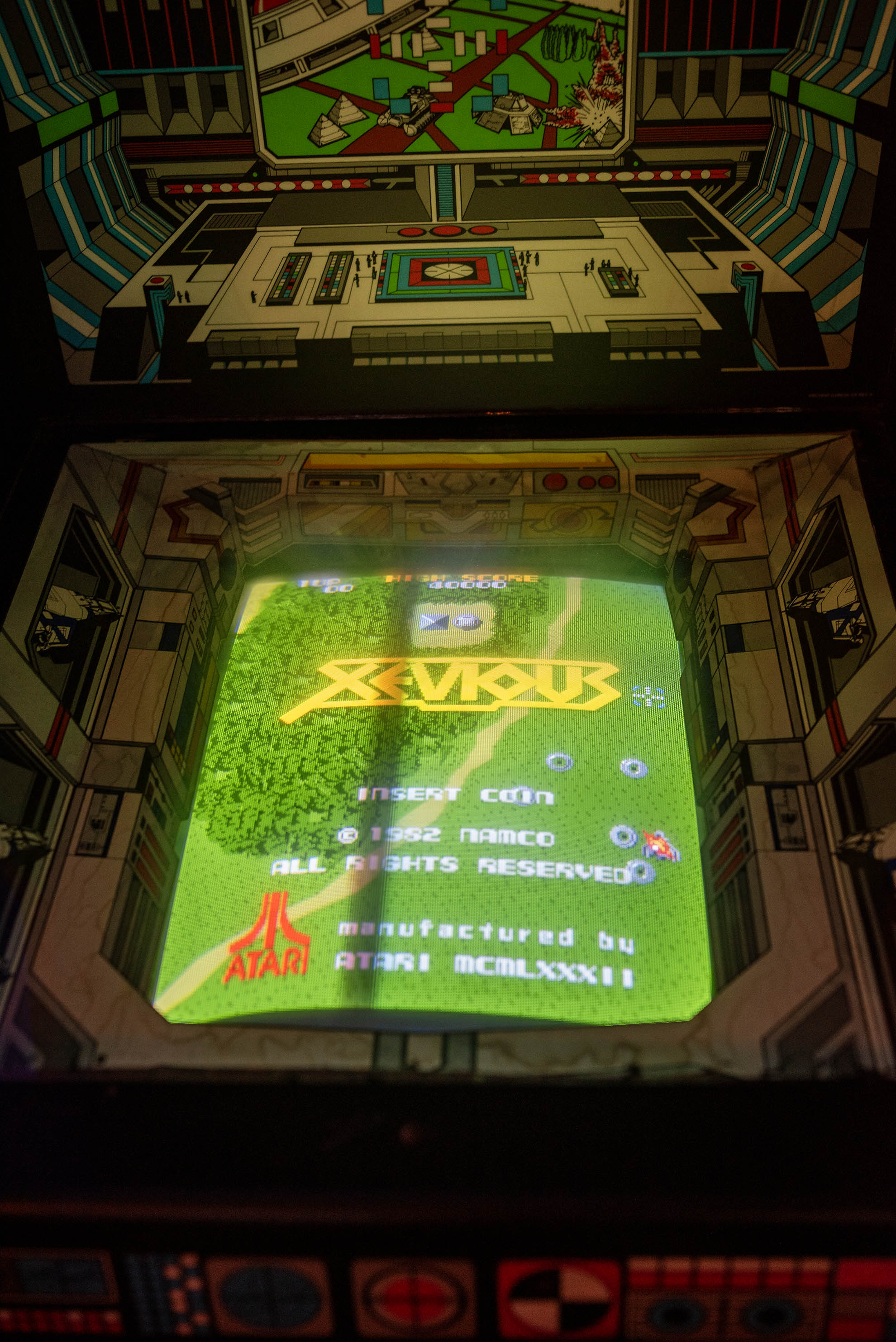
The hardware architecture deserves special attention. Galaga, Xevious, Dig Dug, and Bosconian all share essentially the same CPU board with chip population changes between games. However, each game uses completely different and incompatible video boards - except Xevious and Super Xevious, which share the same video hardware.
This modular approach allowed Namco to leverage proven technology while customizing visual capabilities for each title. The Atari-manufactured boards for North American distribution feature a unique pinout configuration, making them incompatible with the Namco Galaga standard - a consideration that remains important for collectors and arcade operators today.
Cabinet Artistry: The Atari Treatment
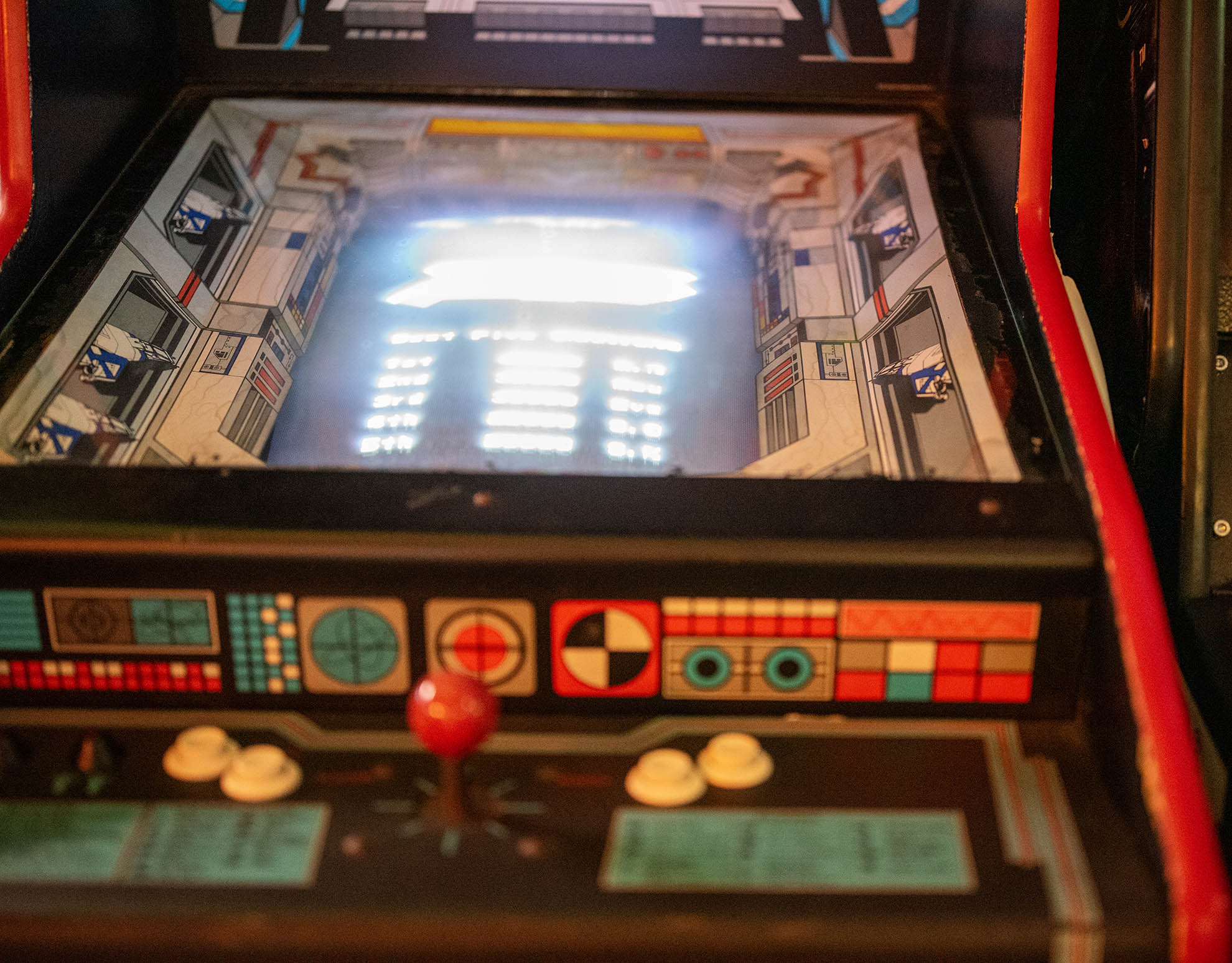
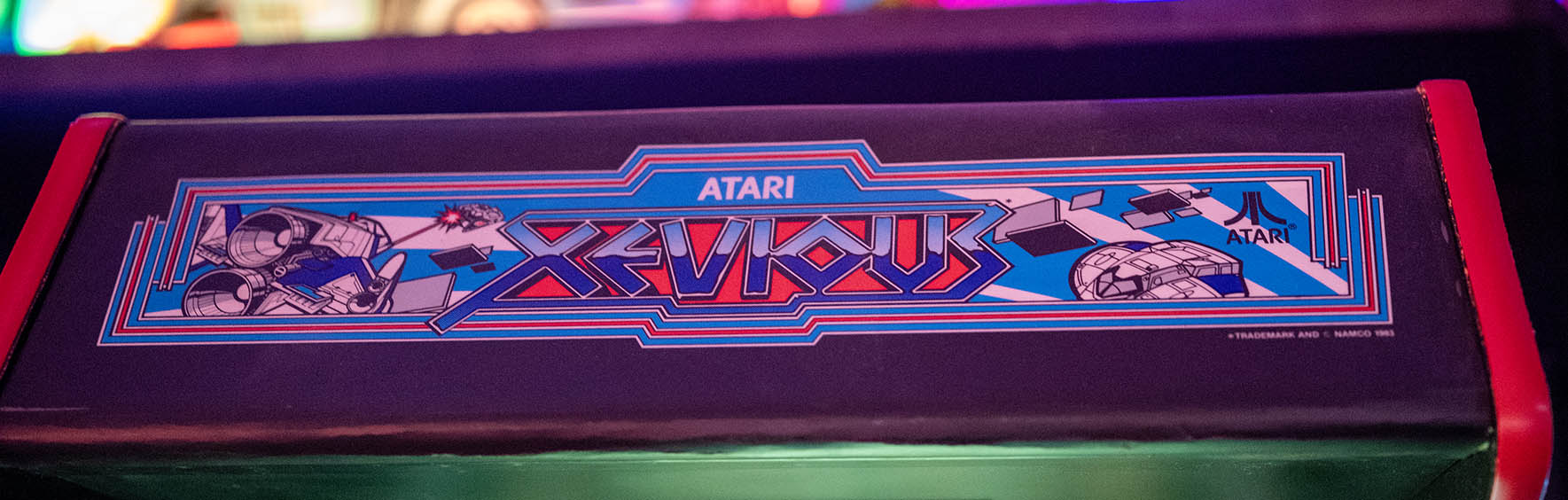
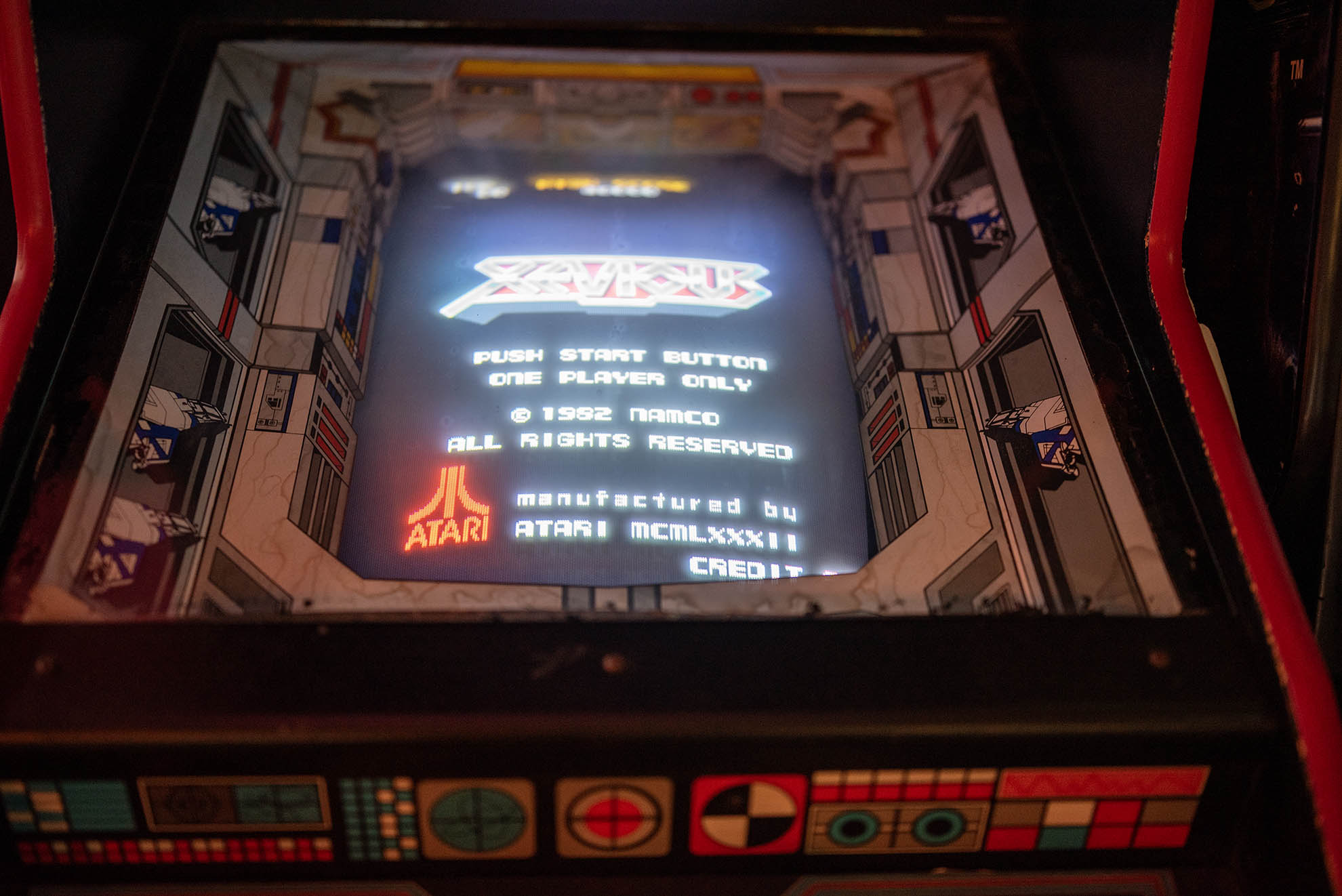
While Japanese arcade versions appeared in Namco's standard cabinet, Atari gave Xevious the full artistic treatment for North American distribution. The result was one of the most gloriously designed cabinets of the golden age.
The upright cabinet weighed 304 pounds and featured a 19-inch Matsushita vertical raster monitor. Controls consisted of an 8-way joystick with two buttons for the Zapper and Blaster weapons. The audio system was unamplified mono requiring a single-channel amplifier. The layout was a single-player ambidextrous design supporting 1-2 players alternating.
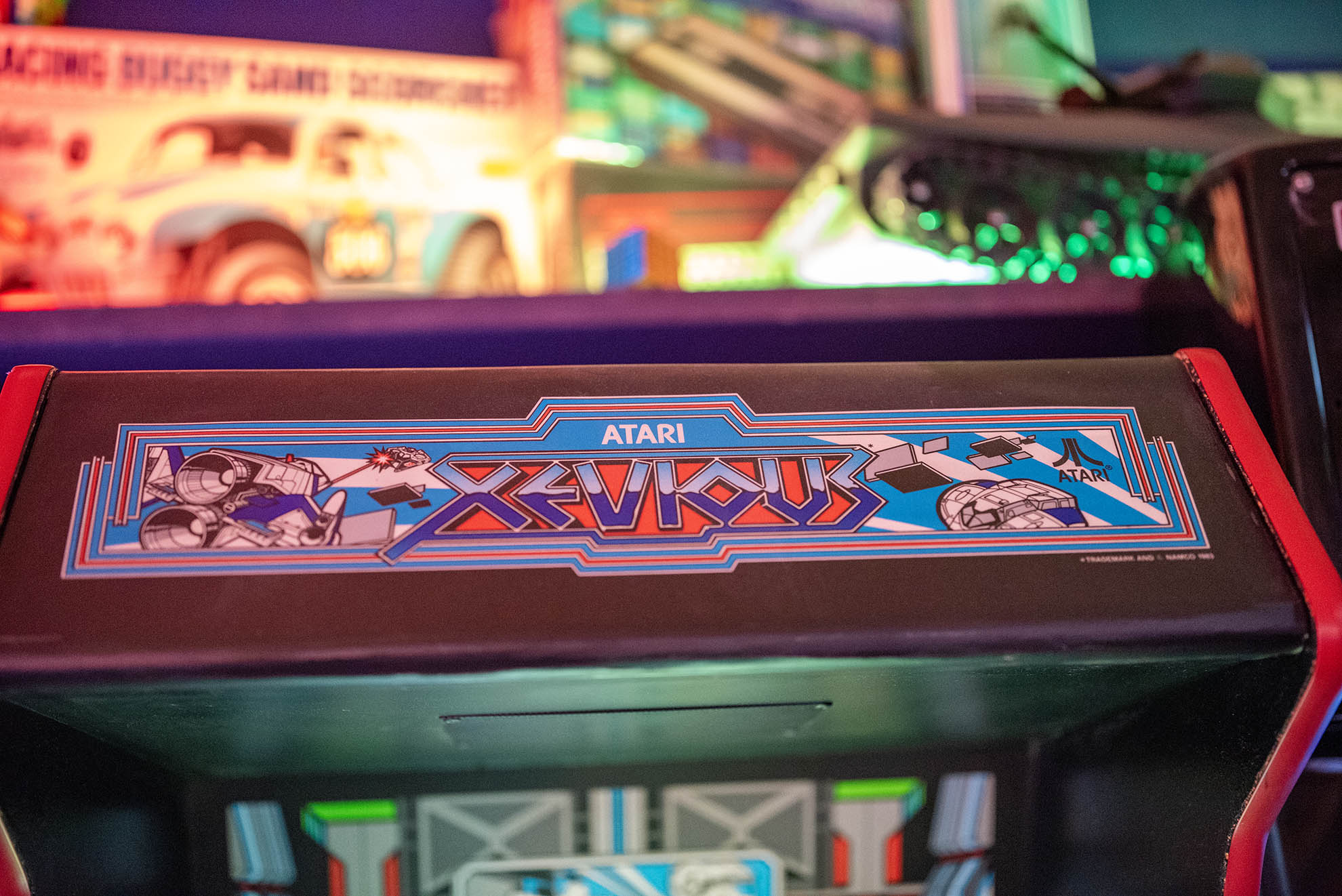
The cabinet artwork featured elaborate science fiction imagery created by Atari's art department, with the original bezel mock-up sketched by designer Mike Jang. The side panels, marquee, control panel overlay, and bezel all received custom artwork that elevated the game's presentation beyond typical arcade fare.
Cocktail cabinet variants also existed, featuring the standard table format with controls on opposing sides for two-player alternating gameplay.
By the end of 1983, Atari had sold 5,295 Xevious cabinets in North America, generating approximately $11.1 million in cabinet sales revenue (equivalent to roughly $35 million in 2024). This made it a solid performer in North American arcades, where it reached number four on the Play Meter arcade charts in July 1983, sharing cabinet space with other Sega classics like Wrestle War.
Revolutionary Gameplay: Two Weapons, One Vision
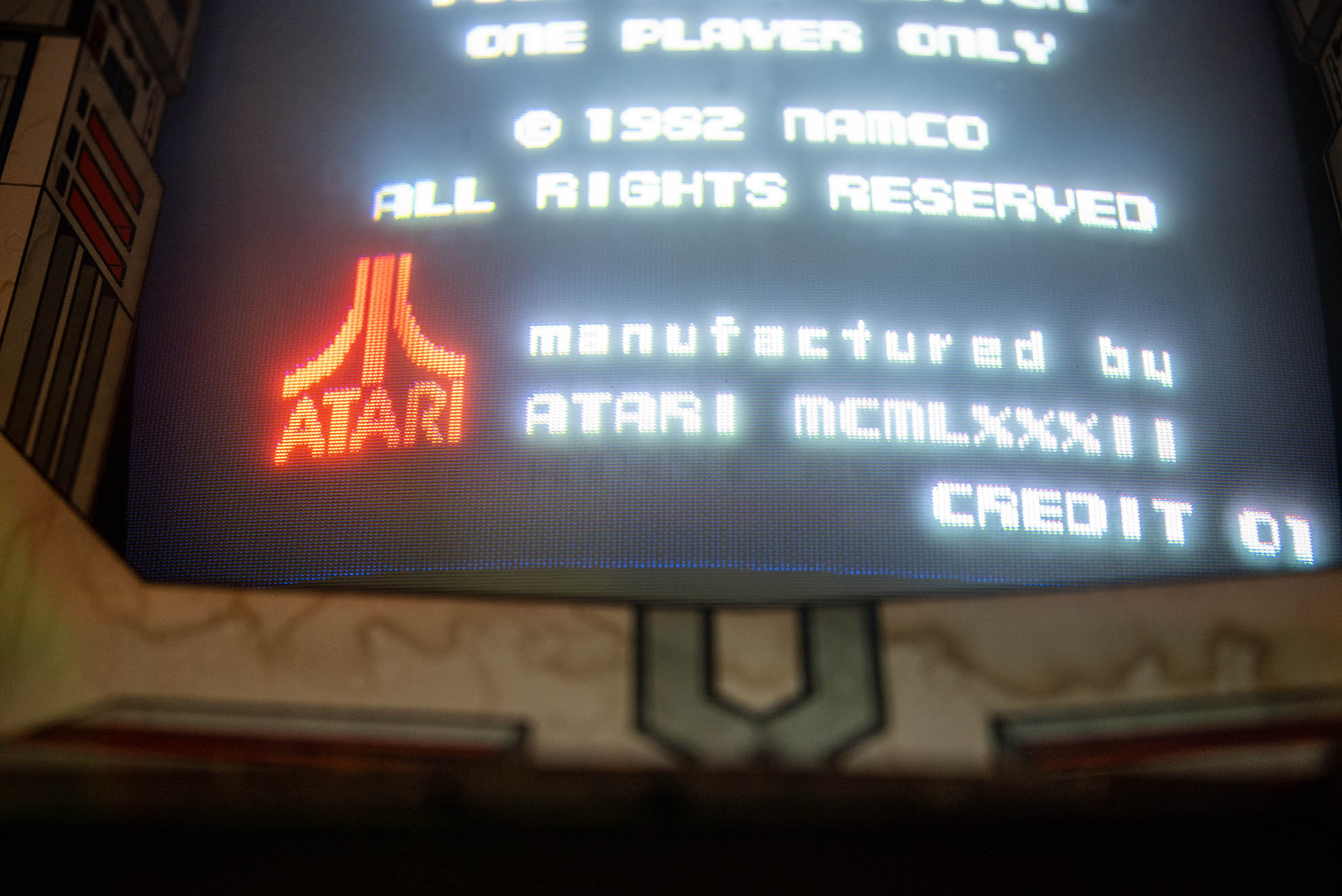
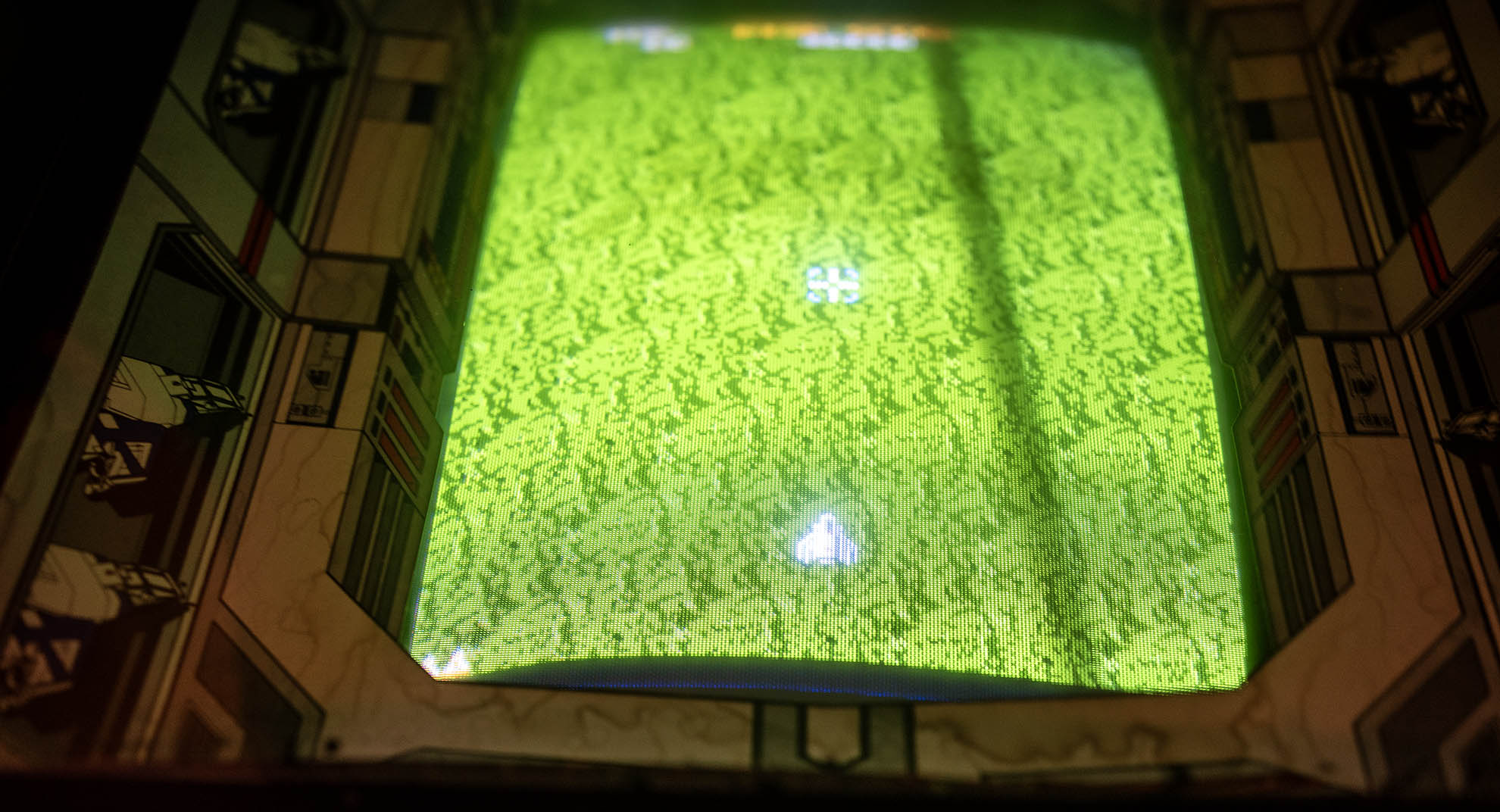
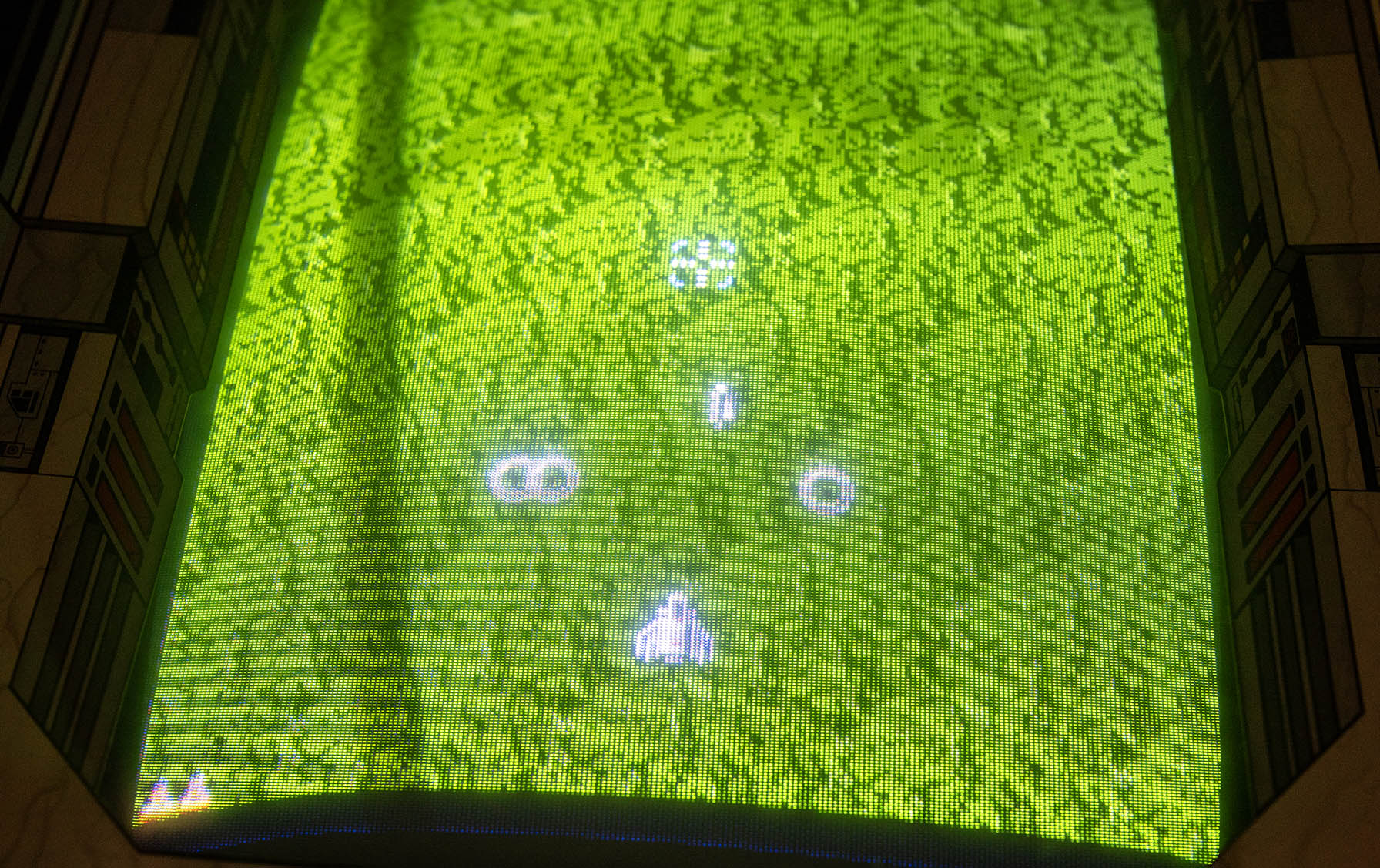
Xevious introduced gameplay innovations that would become genre standards. Players pilot the Solvalou, a sleek attack craft armed with two distinct weapons. The Zapper is an unlimited-ammunition cannon firing forward at airborne enemies, with projectiles that move quickly and require players to anticipate enemy flight paths. The Blaster fires ground-attack bombs guided by a targeting reticle that appears ahead of the Solvalou. This was revolutionary - the reticle flashes red when positioned over a destructible ground target, giving players crucial tactical information.
This dual-weapon system created a fundamentally different experience from previous shooters. Players couldn't simply focus on what was directly ahead; they had to simultaneously manage aerial threats while strategically bombing ground installations. This multitasking requirement increased both challenge and engagement.
The game spans 16 distinct geographical areas separated by forested sections. Each area features varied terrain including forests, airstrips, roads, rivers, and mechanical structures. Unlike the abstract space backgrounds of earlier shooters, Xevious presented a coherent world that scrolled seamlessly beneath the player. The entire playfield consisted of a single 1024 x 2048 pixel hand-drawn image map divided into the 16 playable sections.
Enemy Variety: 26 Types of Threat
Xevious featured unprecedented enemy diversity, with 26 uniquely-behaving enemy types divided between air and ground forces. Among the notable air enemies, Toroids approach from screen corners and swoop toward the player before reversing direction, while Zakatos are black spheres launched by the Andor Genesis mothership. Various fighter craft each have distinct attack patterns that keep players on their toes.
Ground enemies include Barra energy stations shaped like pyramids, Grobda tanks that later received their own spin-off game, Derota defense sites, Logram dome stations, and Domogram rovers. Each ground target requires precise bombing with the Blaster weapon.
The game also introduced one of gaming's earliest boss encounters: the Andor Genesis mothership. This massive flying fortress launches endless streams of projectiles and Zakatos spheres. Players must either destroy all four blaster receptacles or hit the central core to defeat it. Throughout the 16 stages, four Andor Genesis encounters appear: in areas 4, 9, and two in area 14.
Hidden Secrets: Sol Citadels and Special Flags
Xevious pioneered the concept of hidden bonuses not mentioned in game instructions. Two secret elements added significant replay value.
Sol Citadels are hidden towers buried underground that can be revealed by bombing specific locations. The Solvalou's targeting reticle flashes red over these invisible towers, rewarding observant players. Revealing a citadel awards 2,000 points, and destroying it grants another 2,000 points. The Sol Citadels originated from a programming experiment. While implementing the flashing reticle system to indicate destructible targets, Endo thought it would be interesting to have the reticle flash over empty spaces. When Namco executives expressed displeasure at this "bug," Endo claimed it was simply a programming error and left the feature intact.
Special Flags are yellow flags borrowed from Namco's Rally-X that appear in semi-random locations throughout each area. Collecting one grants an extra life. Endo included these as a personal tribute to Rally-X, a game he particularly admired.
The Anti-Piracy Easter Egg: EVEZOO's Signature
One of gaming's most famous hidden messages serves dual purposes: developer credit and bootleg detection. At the start of the game, moving directly to the right side of the screen and continuously firing Blaster bombs reveals the message "NAMCO ORIGINAL / program by EVEZOO."
EVEZOO is Masanobu Endo's developer nickname. This wasn't mere vanity - it was clever anti-piracy technology. On legitimate Namco boards, players see the proper credit. On bootleg copies, the message changes to "DEAD COPY / MAKING copy under NAMCO program" (デッドコピー means bootleg in Japanese).
Various bootleg versions attempted to circumvent this detection. The "Battles" bootleg changed the message to "Prease [sic] enjoy this GAME!" - an amusing typo that immediately identifies unauthorized copies.
Adaptive Difficulty: The Game Fights Back
Xevious implemented early adaptive difficulty - the game literally responds to player skill. Designer Endo programmed the system to monitor player performance and adjust accordingly. When skilled players easily destroy certain enemy types, more challenging variants replace them. The more aggressively you play, the more aggressively enemies respond.
This dynamic difficulty ensured that Xevious remained challenging for experts while remaining accessible to newcomers. It was an elegant solution to the arcade operator's dilemma: games must be difficult enough to generate revenue but not so punishing that players walk away frustrated.
The Maximum Score: 9,999,990 Points
Unlike most arcade games of the era, Xevious has a definitive ending - but not through completing stages. The game continues infinitely, looping back to area 7 after completing area 16. Instead, Xevious ends when players reach the maximum displayable score of 9,999,990 points.
This creates a unique competitive dynamic. Since the game can be "beaten" by reaching maximum score, high-level competition shifts to speedrunning: who can reach 9,999,990 fastest? The Twin Galaxies tournament settings specify three lives (Solvalous), bonus lives awarded at 20,000 and every 60,000 points thereafter, and hard difficulty.
Record-Breaking Commercial Success
Xevious's reception in Japan was extraordinary. Location testing in December 1982 confirmed its potential, and the January 1983 release triggered a phenomenon. The game achieved record-breaking sales figures that hadn't been seen since Space Invaders in 1978.
By November 1983, Xevious ranked as the top-grossing table arcade cabinet on Japan's Game Machine charts. It represented Namco's biggest post-Pac-Man success and cemented the company's position as an industry leader, similar to how Super Metroid would later define its genre.
The cultural impact extended beyond arcades. High score tournaments spread across Japan, while strategy guides documenting the game's secrets and hidden items became bestsellers. The game's mystique - its ancient civilization backstory, hidden elements, and adaptive challenge - created engagement that transcended typical arcade experiences.
The Famicom Revolution: Gaming's First "Killer App"
In 1984, Nintendo opened its Famicom platform to third-party developers. Namco was among the first to capitalize, releasing a Famicom port of Xevious in November 1984. The result changed console gaming history.
The Famicom Xevious sold out within three days. Namco's telephone lines were flooded with calls from players seeking gameplay tips. The port sold over 1.26 million copies in Japan alone, with the NES version eventually reaching 1.5 million units worldwide.
More significantly, Xevious drove console hardware sales. The game is credited with boosting Famicom system sales by nearly two million units, establishing it as the console's first "killer app" - a term that would become industry standard for games that drive hardware adoption.
The profits generated by Famicom Xevious funded construction of Namco's new Ota, Tokyo headquarters in 1985. The building was nicknamed "Xevious" internally - a testament to the game's financial impact on the company.
Musical Legacy: From Arcades to Vinyl
Composer Yuriko Keino, who joined Namco in April 1981, created Xevious's distinctive audio. Possibly Namco's first dedicated sound designer, Keino had previously composed for Dig Dug. For Xevious, she used the Namco sound driver developed by Fukashi Ohmorita and Nobuyuki Ohnogi, writing music in assembly language with hexadecimal notation.
The Xevious soundtrack achieved remarkable cultural penetration. Music from the game was used during the "Starcade Hotline" video game news segments on the American television game show Starcade (1982-1984), introducing the compositions to audiences who might never have entered an arcade.
In 1984, electronic music pioneer Haruomi Hosono (of Yellow Magic Orchestra fame) released "Video Game Music," the first album dedicated to video game soundtracks. The record featured a six-minute Xevious track that halfway through transforms into a remix, looping the opening jingle while arranging sampled sound effects into melody. Hosono also released a 12-inch single titled "Super Xevious (Video Game Music Dance Mix)" - considered the first techno remix of a video game tune.
The GAMP Saga: Gaming's First Elaborate Backstory
Xevious featured an unusually sophisticated narrative for its era. Designer Endo wrote a complete science fiction short story called "Fardraut" (ファードラウト) that established the game's mythology.
One hundred thousand years ago, humanity created the Genetic Artificial Matrix Producer (GAMP), a bio-computer producing clone laborers. When Earth's ice age approached, the GAMPs organized humanity's evacuation to six colony planets, with the final group bound for planet Xevious. The humans who remained on Earth became our ancestors.
The enemies in Xevious are the returning GAMP civilization, seeking to reclaim their original homeworld. This twist - humanity as the "aliens" defending against the true original inhabitants - added unexpected depth to arcade action.
The Nazca Lines featured in the game's terrain connected to this mythology. Archaeologists in the story discover that these ancient formations hide SOL towers - the same buried structures players reveal during gameplay.
Super Xevious: The 1984 Update
Released in 1984, Super Xevious served as a conversion kit for existing Xevious cabinets rather than a true sequel. The update introduced new enemy types including fighter jets, tanks, helicopters, and silver-plated Galaxian flagships. Difficulty increased with more aggressive enemies and faster projectiles. The locations of Sol Citadels and Special Flags were relocated, and new scoring traps meant some enemies would reset scores to zero when destroyed.
Using identical graphics and background maps, Super Xevious represented a "ROM swap" upgrade for arcade operators seeking to refresh their machines. Critical reception was mixed - the increased difficulty pleased some players while alienating others accustomed to the original's balance.
Influence on Gaming: The Vertical Shooter Template
Xevious's impact on game design cannot be overstated. It established the fundamental template for vertical shooters that persists today. Dual weapon systems with separate air and ground attacks became common in shooters. Detailed terrain with scrolling environments featuring geographic features replaced abstract backgrounds. Boss encounters with large, multi-part enemies requiring strategic targeting became standard. Hidden bonuses rewarding exploration and experimentation added depth, and adaptive difficulty with dynamic challenge adjustment based on player skill kept games engaging.
Games directly influenced by Xevious include TwinBee (Konami, 1985), which adopted ground/air attack separation with colorful aesthetics; RayForce (Taito, 1993), which pushed ground targeting to its logical extreme; the Raiden series, which built on Xevious's military-themed vertical scrolling framework; and Zanac, which inherited difficulty scaling concepts.
As gaming historians note: "The basic fundamentals and formalization of what a vertical STG even was, were pretty much solved by Xevious."
The Legacy Continues
Xevious spawned numerous sequels, remakes, and adaptations. Super Xevious (1984) provided an enhanced difficulty update. Solvalou (1991) offered a first-person perspective reimagining. Xevious 3D/G (1995) brought the franchise to PlayStation with polygon-based graphics. Xevious Arrangement (1995) updated the game for Namco Classic Collection Vol. 1.
The game remains playable through various compilations and Hamster Corporation's Arcade Archives series for modern platforms.
Xevious exists at a unique intersection of technical innovation, narrative ambition, and pure arcade excellence. When Masanobu Endo - a recent graduate who learned programming in a month - sat down to rival Scramble, he created something that transcended its origins entirely. Xevious didn't just compete with existing shooters; it established the vocabulary that defined the genre for generations.
All arcade cabinet photos taken by the author at The Pixel Bunker.
Game Information
| Developer | Namco |
| Publisher | Namco (Japan/Europe), Atari Inc. (North America) |
| Release Date | January 1983 (Japan), February 1983 (USA) |
| Platform | Arcade (Namco Galaga Hardware) |
| Genre | Vertical Scrolling Shooter (see also: R-Type Tactics) |
| Players | 1-2 (alternating) |
| Display | Raster, vertical orientation, 288x224 |
| Main CPU | 3x Zilog Z80 |
| Sound | Namco 3-channel PSG |
| Controls | 8-way joystick, 2 buttons (Zapper/Blaster) |
| Designer | Masanobu Endo (EVEZOO) |
| Composer | Yuriko Keino |
| Maximum Score | 9,999,990 points |
| US Cabinets Sold | 5,295 (grossing $11.1 million) |
| Famicom Sales | 1.26 million (Japan), 1.5 million (worldwide) |
| Sequels | Super Xevious (1984), Solvalou (1991), Xevious 3D/G (1995) |
| Key Innovation | Established vertical shooter template, dual weapon system, hidden secrets |
Gallery
Get Gaming News and Features First
Stay updated with the latest gaming news and exclusive content.