Resident Evil Village: Lady Dimitrescu, Four Lords, and Capcom's Horror Masterpiece
Explore Resident Evil Village's Lady Dimitrescu phenomenon, Four Lords design, Mother Miranda's Umbrella connection, RE Engine tech, and 10+ million copies sold.
Resident Evil Village marked a triumphant evolution for Capcom's legendary survival horror franchise, becoming the fastest-selling title in series history by reaching 10 million units sold. Released during the series' 25th anniversary celebration in May 2021, Village delivered an unforgettable experience that merged the atmospheric horror of Resident Evil 7 with action-oriented gameplay reminiscent of Resident Evil 4. The game's announcement trailer in June 2020 immediately captured global attention, but it was the reveal of Lady Alcina Dimitrescu that would transform Village into a cultural phenomenon unlike anything the series had seen before.
| Title (EN) | Resident Evil Village |
| Title (JP) | バイオハザード ヴィレッジ (Biohazard Village) |
| Developer | Capcom |
| Publisher | Capcom |
| Release Date | May 7, 2021 |
| Platforms | PS5, PS4, Xbox Series X/S, Xbox One, PC, Switch (Cloud), Mac, iOS, PSVR2 |
| Engine | RE Engine |
| Genre | Survival Horror |
Development Philosophy: Death-Defying Survival Horror

Director Morimasa Sato and the development team at Capcom crafted Village with a clear vision they described as "death-defying survival horror" (決死のサバイバルホラー). In extensive interviews with Japanese gaming publications including 4Gamer and Famitsu, Sato explained that the village setting was chosen specifically because villages inherently carry an unsettling quality in horror traditions. The isolated rural community, cut off from modern society and governed by mysterious customs, provided the perfect backdrop for psychological terror.
The development team studied European folklore extensively, drawing inspiration from Romanian village architecture, Gothic castle designs, and various mythological creatures. The game's structure deliberately mirrors Resident Evil 4's castle-village-industrial progression while maintaining the immersive first-person perspective introduced in Resident Evil 7. This hybrid approach satisfied both longtime fans who praised RE4's pacing and newcomers who discovered the series through RE7's visceral horror.
Capcom's photogrammetry workflow, refined through years of RE Engine development, achieved unprecedented realism. Character models were created by scanning real actors and environments, then meticulously adjusted by artists to achieve the perfect balance between photorealism and stylized horror aesthetics. The RE Engine's subsurface scattering technology proved particularly crucial for rendering the pale, porcelain-like skin of the Dimitrescu family, creating an uncanny valley effect that enhanced their supernatural presence.
The Four Lords: Masters of Their Domains
Village's most celebrated innovation was its four distinct antagonists, each ruling over a unique area with their own aesthetic, gameplay mechanics, and horror philosophy. The Four Lords system allowed Capcom to deliver four completely different horror experiences within a single cohesive narrative.
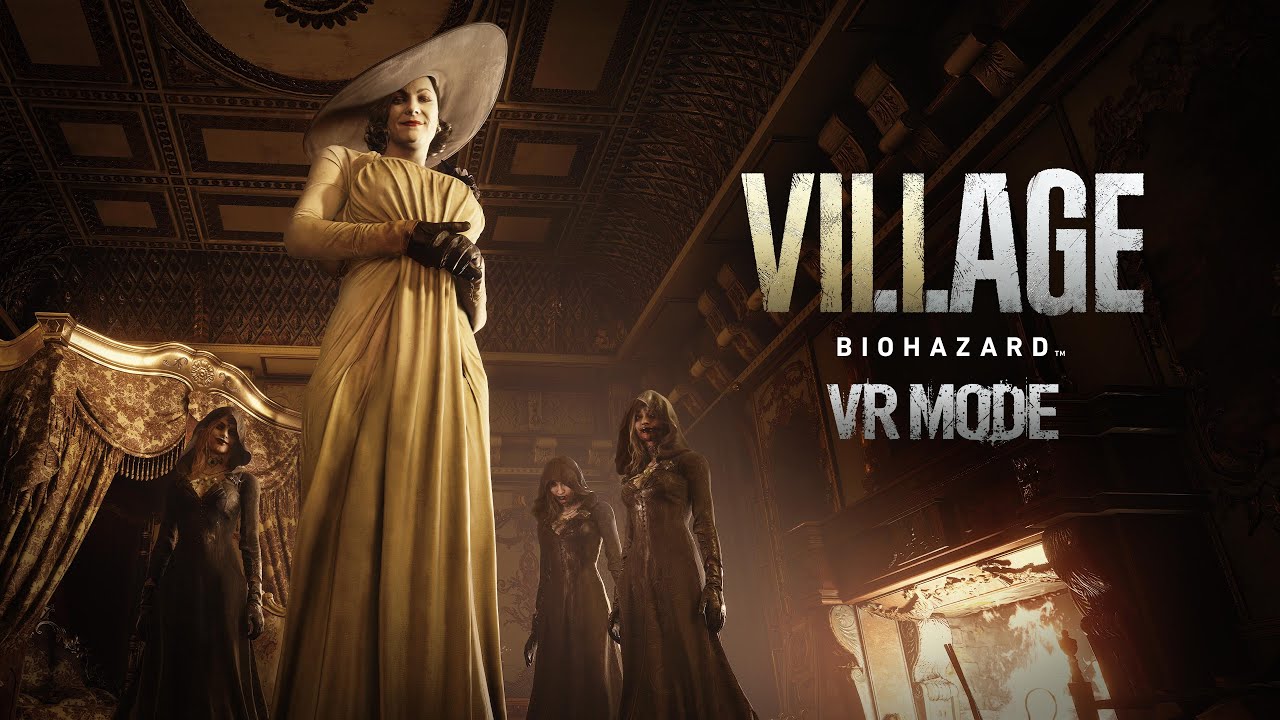
Lady Alcina Dimitrescu governs Castle Dimitrescu, a sprawling Gothic fortress that channels classic vampire fiction and aristocratic horror. Standing at an imposing 2.9 meters (9 feet 6 inches), she was designed to embody both elegance and menace. Art director Tomonori Takano revealed in Japanese interviews that her design drew inspiration from Elizabeth Báthory, the infamous Hungarian noblewoman, combined with the Japanese urban legend of Hachishaku-sama (八尺様), a tall female spirit. Her three daughters (Bela, Cassandra, and Daniela) decompose into swarms of insects, showcasing the RE Engine's advanced particle effects while creating genuinely unsettling pursuit sequences.
Karl Heisenberg controls the factory district, representing industrial horror and body modification nightmares. The development team designed him as conceptually the "strongest" of the Four Lords, possessing electromagnetic abilities that allow him to control metal and create grotesque mechanical hybrids called Soldats. His domain provides the game's most action-oriented segment, featuring intense combat encounters and RE4-style shoot-outs.
Donna Beneviento and her porcelain doll Angie deliver pure psychological horror in House Beneviento. This section strips away Ethan's weapons entirely, forcing players through one of the most terrifying sequences in franchise history. The baby monster that pursues Ethan through the basement became infamous among players, with Japanese gaming communities on 5ch dedicating extensive discussion threads to this single encounter. Donna's backstory as a recluse who communicates only through her doll due to severe social anxiety caused by facial disfigurement adds tragic depth to her villainy.
Salvatore Moreau was deliberately designed as the "most repulsive" (最も嫌悪感を催す) of the Four Lords, according to director Sato. His aquatic mutations and the reservoir setting evoke body horror and creature-feature cinema. Japanese fans noted connections to kappa folklore and Innsmouth-style fish-people horror. The character's pathetic desire for Mother Miranda's approval creates unexpected pathos beneath the surface-level grotesquerie.
The Lady Dimitrescu Phenomenon
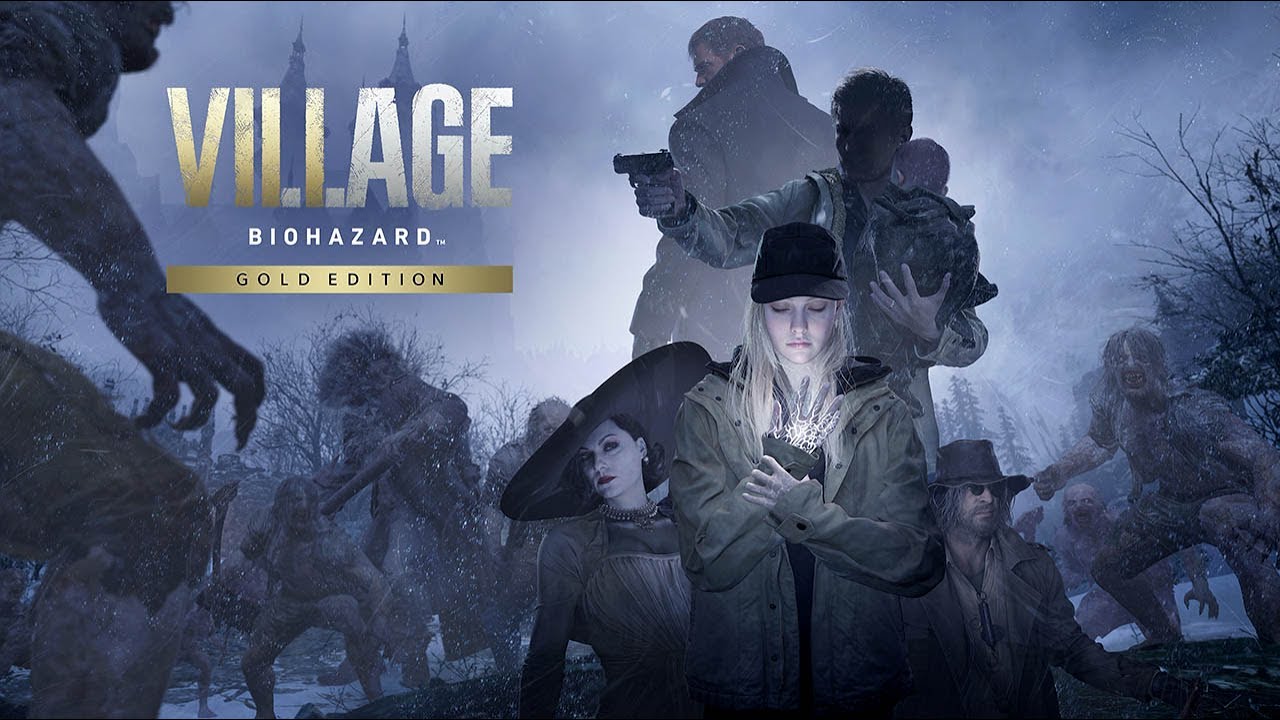
No discussion of Resident Evil Village would be complete without addressing the unprecedented cultural impact of Lady Alcina Dimitrescu. When Capcom officially revealed her height as 2.9 meters during a Japanese developer commentary, the internet erupted. Within days, Lady Dimitrescu became one of the most discussed video game characters in social media history, spawning countless fan artworks, cosplays, and memes.
Japanese fan communities embraced her with the concept of "ママみ" (mamami), roughly translating to "motherly vibes" or "mommy energy," reflecting a specific appeal that transcended traditional villain dynamics. Voice actress Kikuko Inoue, beloved for her roles as elegant female characters in anime, brought sophisticated menace to the Japanese performance.
The character's design philosophy prioritized elegant intimidation. Her wide-brimmed hat, form-fitting white dress, and elongated fingers with razor-sharp nails created an instantly iconic silhouette. The RE Engine's advanced cloth simulation brought her dress to life with realistic draping and movement, while subsurface scattering on her skin created the pale, almost translucent quality associated with vampire fiction.
The Story: Ethan Winters' Final Chapter
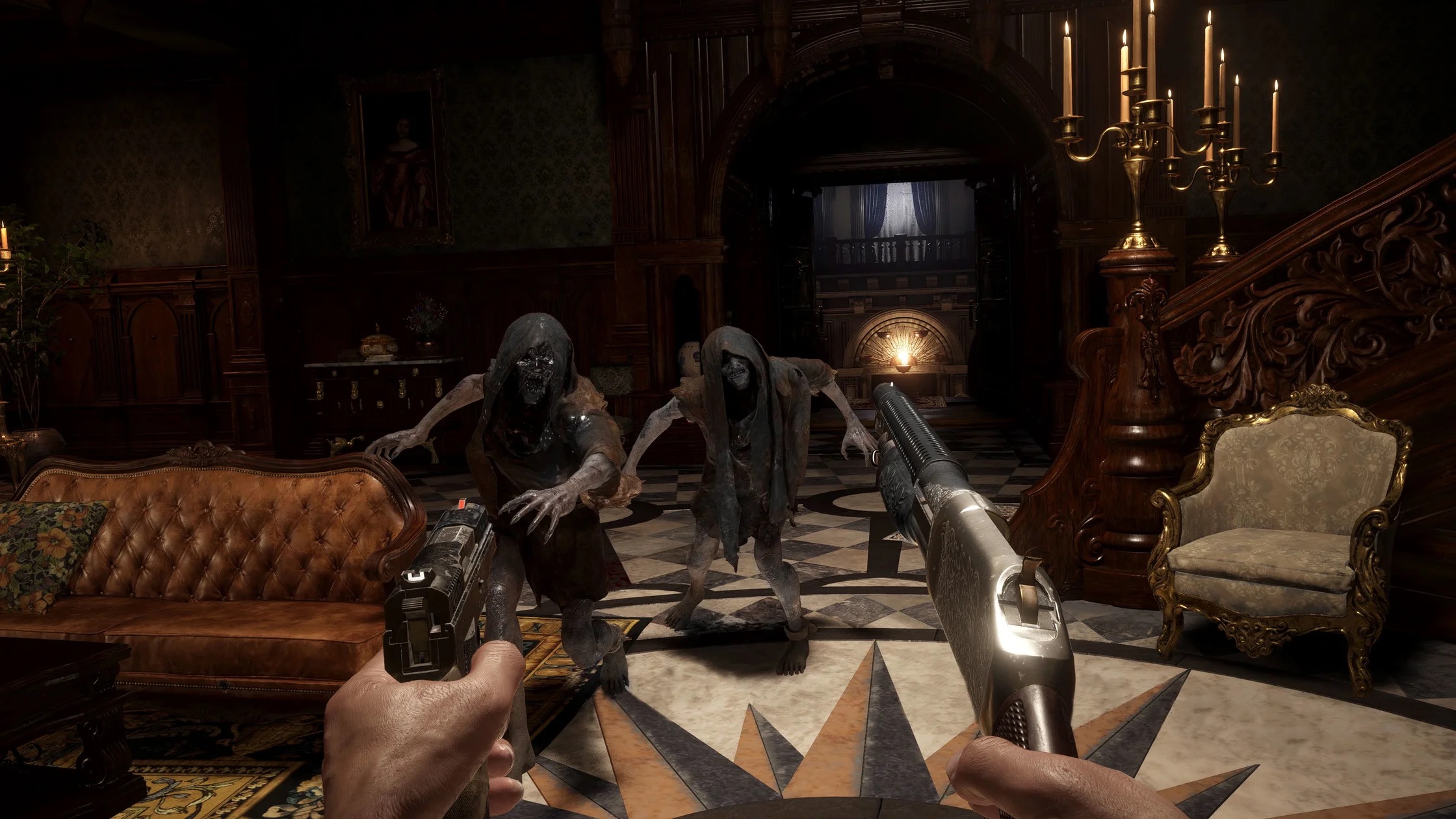
Resident Evil Village continues directly from the events of Resident Evil 7, following Ethan Winters and his wife Mia as they attempt to rebuild their lives in Europe under BSAA protection. Their peaceful existence shatters when Chris Redfield, the series' longtime hero, seemingly murders Mia and kidnaps their infant daughter Rose.
The narrative's central mystery involves Mother Miranda, the ancient leader of the village who seeks to use Rose as a vessel to resurrect her deceased daughter Eva. Miranda has ruled the village for centuries, her research into the Megamycete (a massive mold colony) granting her shape-shifting abilities and functional immortality. The game's most shocking twist reveals that Mia's killer was actually Miranda in disguise, having infiltrated the Winters household weeks earlier.
Ethan's journey through the Four Lords' domains serves as both rescue mission and gradual revelation of his true nature. The horrifying truth is that Ethan actually died during RE7's opening hours and his consciousness has been sustained by mold-based regeneration, a revelation that recontextualizes both games. His body's regenerative limits are pushed beyond breaking point during the final confrontation, forcing the ultimate sacrifice to save Rose and destroy the Megamycete.
Mother Miranda and the Origins of Umbrella
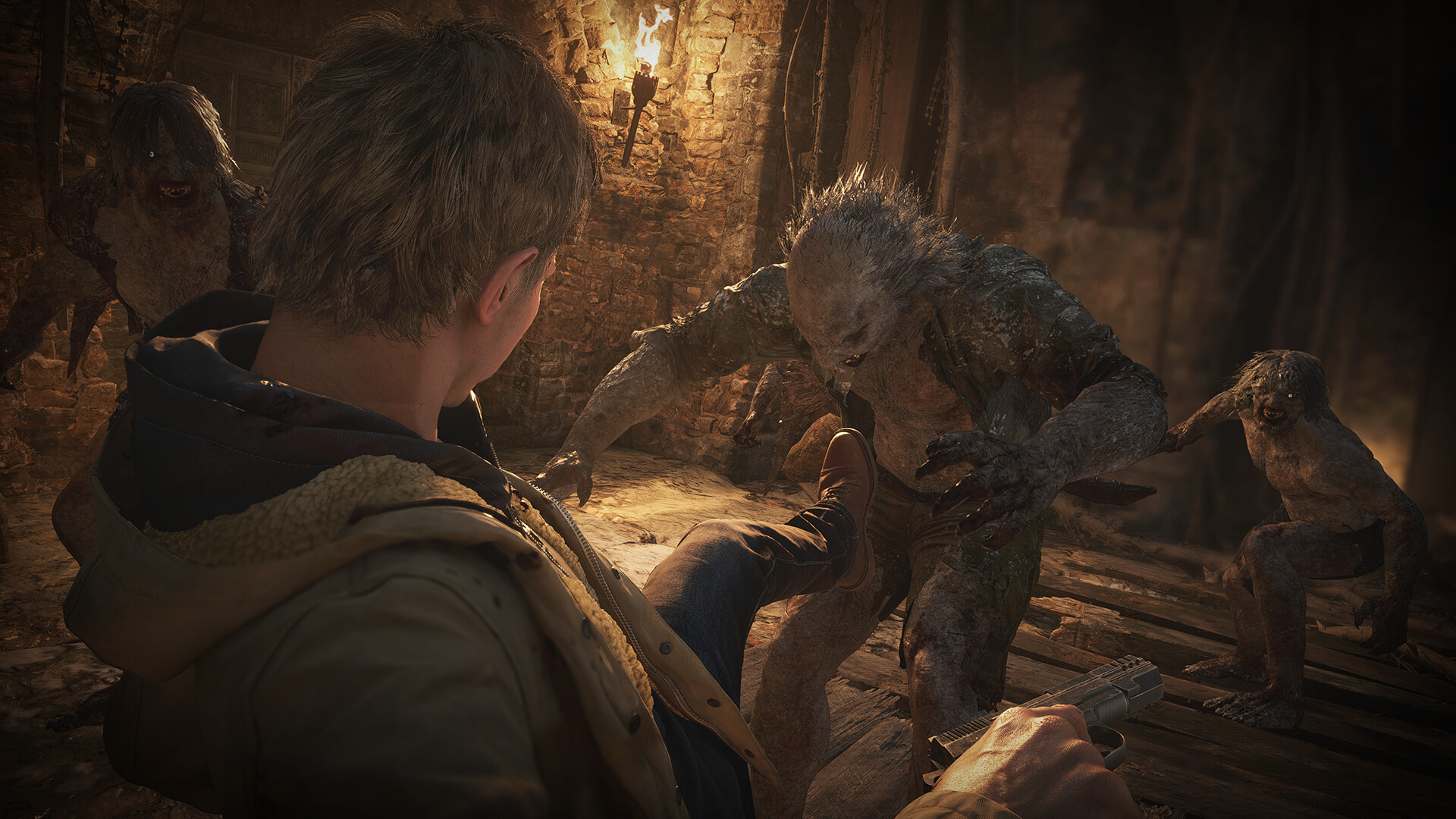
Resident Evil Village delivers perhaps the most significant lore revelation in series history: Mother Miranda's direct connection to the founding of Umbrella Corporation. Documents scattered throughout the game reveal that Oswell Spencer, Umbrella's eventual founder, discovered Miranda's village during the 1950s after being rescued from an avalanche by her followers.
Spencer spent years studying alongside Miranda, learning about the Megamycete's mutagenic properties and her research into resurrection through mold infection. The Four Houses sigil, representing the village's four ruling families, directly inspired Umbrella's iconic logo. Miranda's work combining the Progenitor Virus with mold samples contributed to the theoretical framework that would eventually produce the T-Virus.
This revelation retroactively enriches the entire Resident Evil saga. Without Miranda's foundational research and Spencer's theft of her concepts, Umbrella would never have existed. The pharmaceutical corporation's experiments, the Raccoon City incident, Wesker's evolution, and every subsequent bioweapon disaster can trace lineage back to a grieving mother's attempt to resurrect her daughter in an isolated European village.
RE Engine: Next-Generation Horror
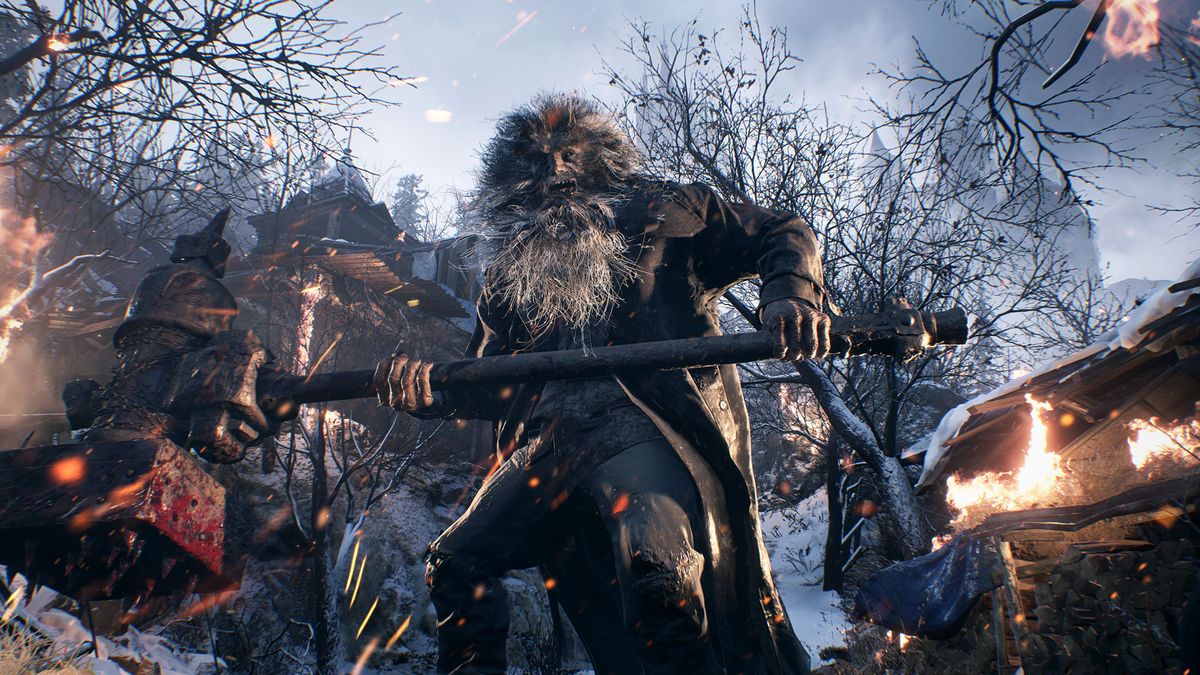
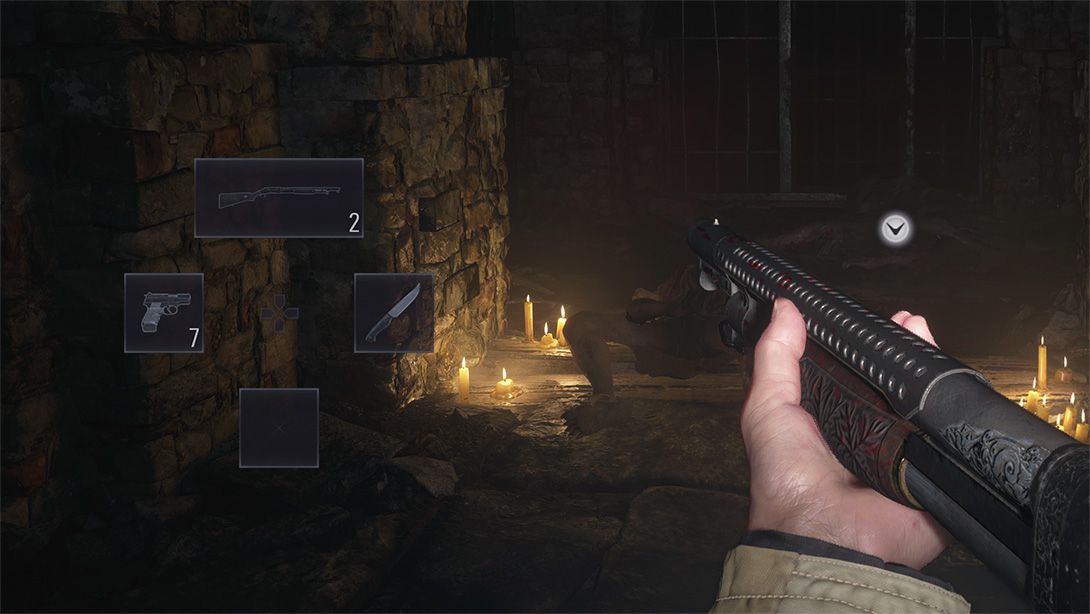
Resident Evil Village showcased the RE Engine's capabilities on next-generation hardware, delivering technical achievements that established new benchmarks for the horror genre. Ray-tracing implementation allows for realistic reflections in the castle's mirrors and polished surfaces, creating gameplay opportunities where players spot enemies in reflections before direct confrontation.
PlayStation 5 and Xbox Series X deliver native 4K resolution at 60fps in performance mode, or 4K at 45fps with ray-tracing enabled. The PS5 version specifically benefits from near-instantaneous loading through SSD optimization and DualSense haptic feedback that conveys environmental textures, from crunching snow underfoot to the recoil of different weapons.
PlayStation VR2 support, added in February 2023, provides full virtual reality immersion throughout the complete campaign. The first-person perspective translates naturally to VR, though the intensity increase caused by Lady Dimitrescu encounters in virtual reality has been widely discussed in Japanese gaming communities.
Mercenaries Mode and The Winters' Expansion

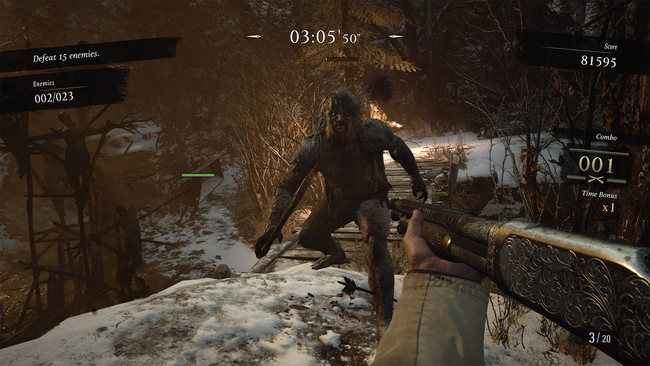
The Mercenaries mode returns in Village, offering eight stages of intense arcade-style combat that tests players' mastery of the game's mechanics. Each stage must be completed within strict time limits while achieving score thresholds for B, A, S, and SS ranks.
The Mercenaries Additional Orders DLC expanded the mode dramatically by adding playable characters beyond Ethan Winters. Lady Dimitrescu plays completely differently from standard characters, with her talons replacing firearms, her vampire abilities providing unique traversal options, and her daughters assisting in combat. Karl Heisenberg manipulates metal objects as weapons, and Chris Redfield brings military precision with enhanced weapon handling.
The Winters' Expansion DLC, released in October 2022, provided the Shadows of Rose story campaign, following adult Rose Winters sixteen years after Village's conclusion as she enters the Megamycete's consciousness realm. Third-Person Mode fulfills a common fan request by allowing the main Village campaign to be experienced from an over-the-shoulder perspective similar to Resident Evil 4.
Platform Versions and Sales Success
Resident Evil Village released across an unprecedented range of platforms:
- PlayStation 5: 4K/60fps performance mode, ray-tracing, DualSense haptics, PSVR2 support
- Xbox Series X: 4K/60fps, Smart Delivery, ray-tracing enabled
- PlayStation 4/Xbox One: 1080p variable framerate, optimized for older hardware
- PC: Scalable settings, AMD FidelityFX, NVIDIA DLSS, ray-tracing
- Nintendo Switch: Cloud streaming version (October 2022)
- Mac: Apple Silicon native support (October 2022)
- iOS: iPhone 15 Pro and iPad support (October 2023)
Village achieved 10 million units sold faster than any previous Resident Evil title, validating Capcom's hybrid horror approach. The combination of RE7's first-person intensity with RE4's action variety created broad appeal that expanded the franchise's audience while satisfying existing fans.
Japanese gaming publications awarded Village strong scores, with community reception proving even more enthusiastic. The designation "神ゲー" (kamige/god game) appeared frequently in Japanese fan discussions, particularly regarding the Castle Dimitrescu and House Beneviento sections. As Capcom develops Resident Evil 9, Village's legacy continues influencing the franchise's direction. The Four Lords system proved that Resident Evil can deliver radically different horror experiences within single games, and Lady Dimitrescu's breakout popularity demonstrated untapped potential in memorable villain design.
Gallery
Get Gaming News and Features First
Stay updated with the latest gaming news and exclusive content.